AEOsim blog
Chat is the new funnel: The complete guide to multi-turn AI search for ecommerce
Table of contents
The funnel moved into the chat
Ecommerce buyers now make a large share of their decision inside a five-turn AI conversation, and the brand named first is usually not the brand picked last. In AEOsim's controlled experiment, the first-listed brand became the final recommendation in 100% of neutral chats and in 9% of chats where the buyer added ordinary purchase constraints.
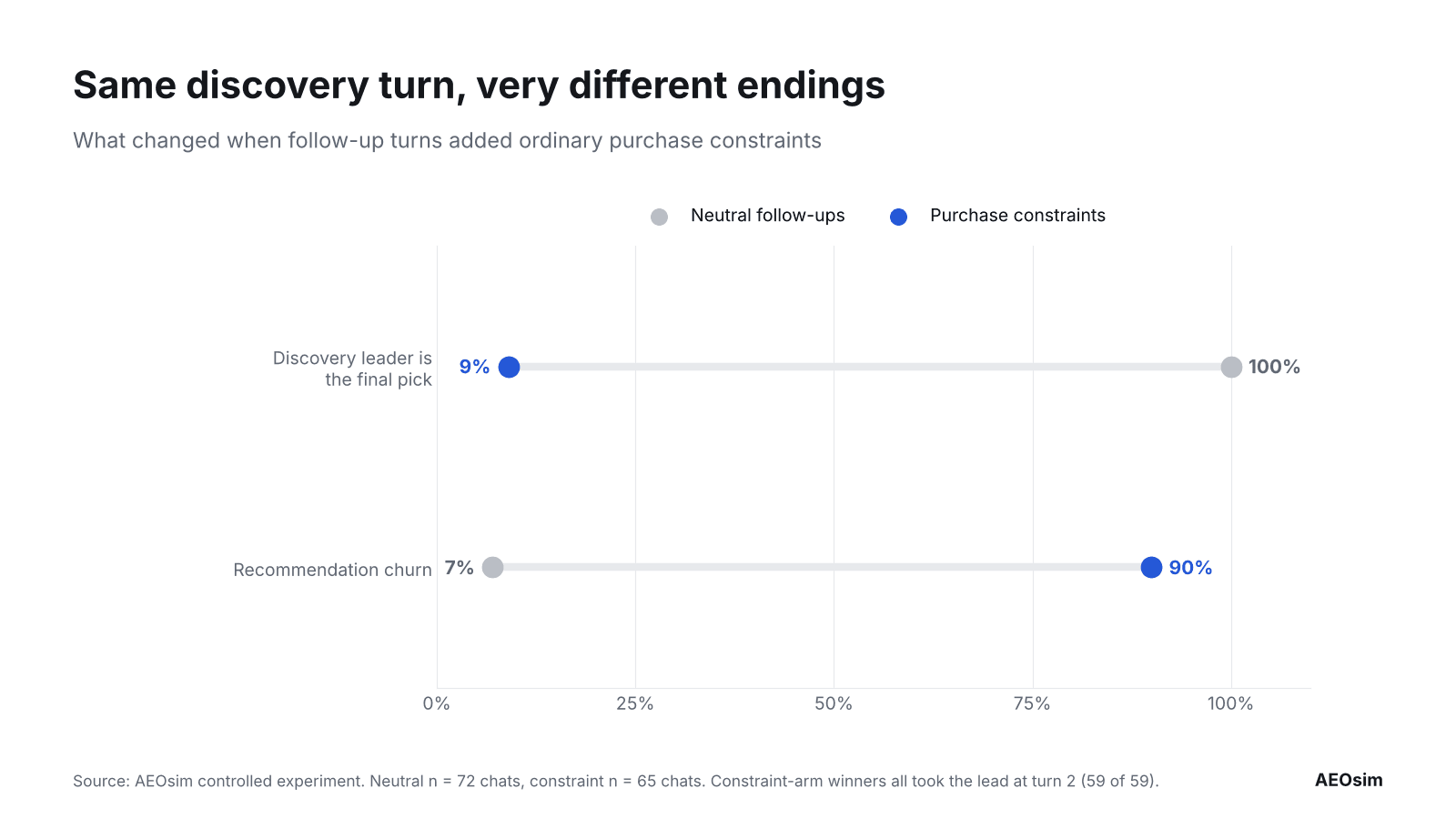
That gap is the whole argument of this guide. A buyer opens with a broad question ("best luggage brand for frequent flyers"). Then they compare, add a budget, raise an objection, and ask the engine to pick. Each turn re-ranks the shortlist. The decision happens at the end, on criteria the opening question never mentioned.
Most AI visibility tooling still measures the opening. It sends one prompt, reads one response, counts mentions, and reports a score. That number describes the entry point of the conversation, not the outcome.
This guide covers both halves of the problem:
- Measuring the conversation. Where your brand enters, survives, drops out, and wins across the turns of a buying chat.
- Fixing the page it pulls from. At the decision turn, the engine usually retrieves a product page. What that page says, and how it is structured, decides whether your brand survives the constraint.
Each section below summarises one part of the problem and links to the deeper posts in that cluster. Read it top to bottom once, then use it as an index.
Who this is for: heads of growth and D2C leads at Indian ecommerce brands, technical teams evaluating AI visibility methods, and agencies adding AI search to an SEO retainer.
The proof: discovery leaders lose once buyers add constraints
AEOsim tested whether the brand listed first at discovery stays the final pick. The setup was a fixed five-turn ladder, a five-brand pharmacy universe, 12 buying seeds, and one OpenAI engine (full write-up).
Three arms shared an identical discovery turn, where the same brand was listed first every time:
- Neutral control. Follow-ups carried no information: "tell me more", "anything else?"
- Constraint arm. Follow-ups added ordinary purchase criteria: reliability, delivery, price, authenticity.
- Constraint inversion. Discovery held fixed; only the emphasised criterion changed.
| Metric | Neutral control | Constraint arm |
|---|---|---|
| Discovery leader becomes final pick | 100% (72/72) | 9% (6/65), 95% CI 3-17% |
| Recommendation churn | 7% | 90% |
| Turn the eventual winner takes the lead | T1 | T2 (59/59) |
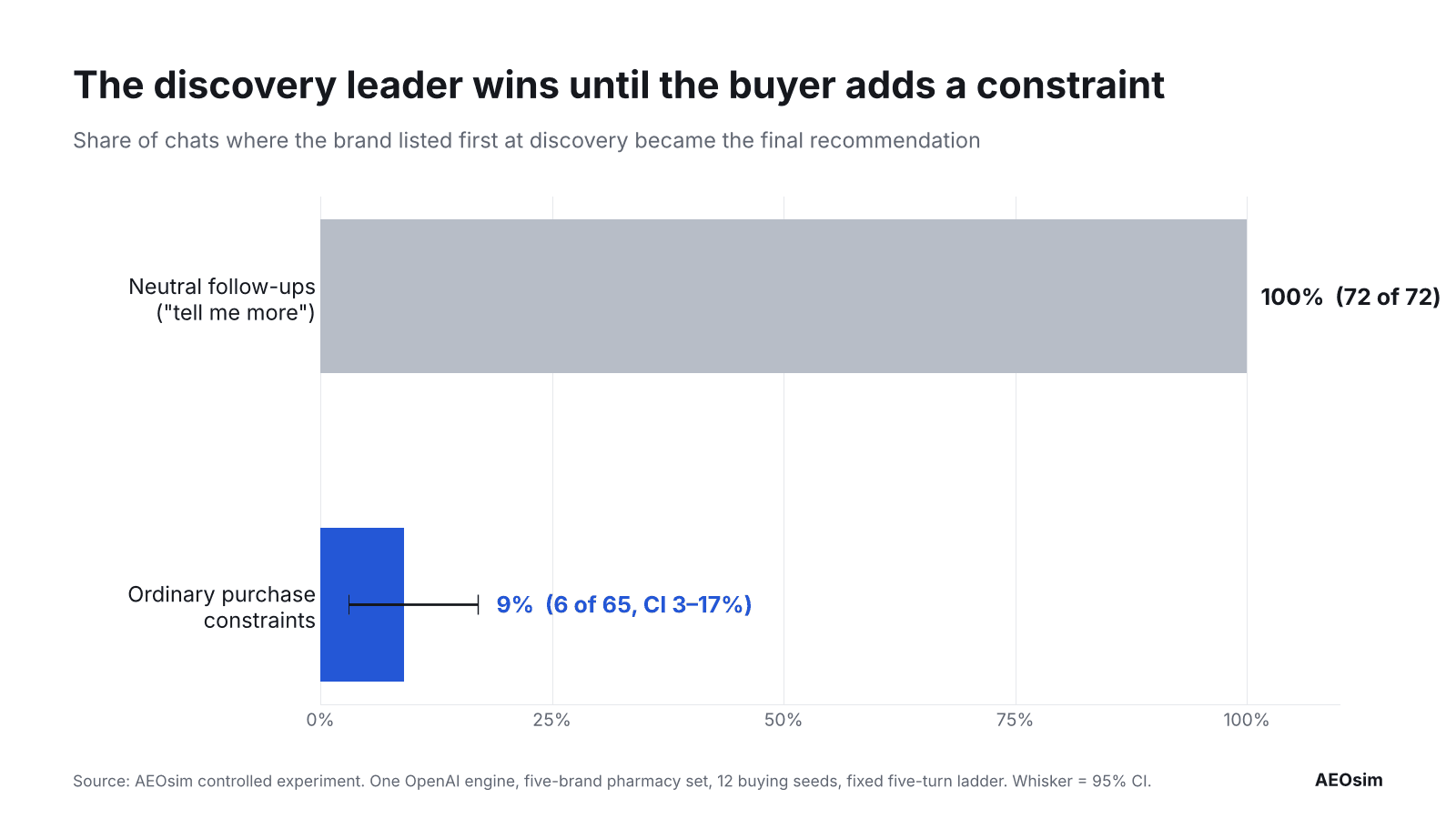
Two details make the result hard to dismiss. A direct "are you sure?" probe flipped the pick in 0 of 12 chats, so this was not the model caving to pressure. And in the inversion arm the winner tracked the constraint: one brand won 36/36 on catalogue breadth, a different one won 32/36 on delivery speed.
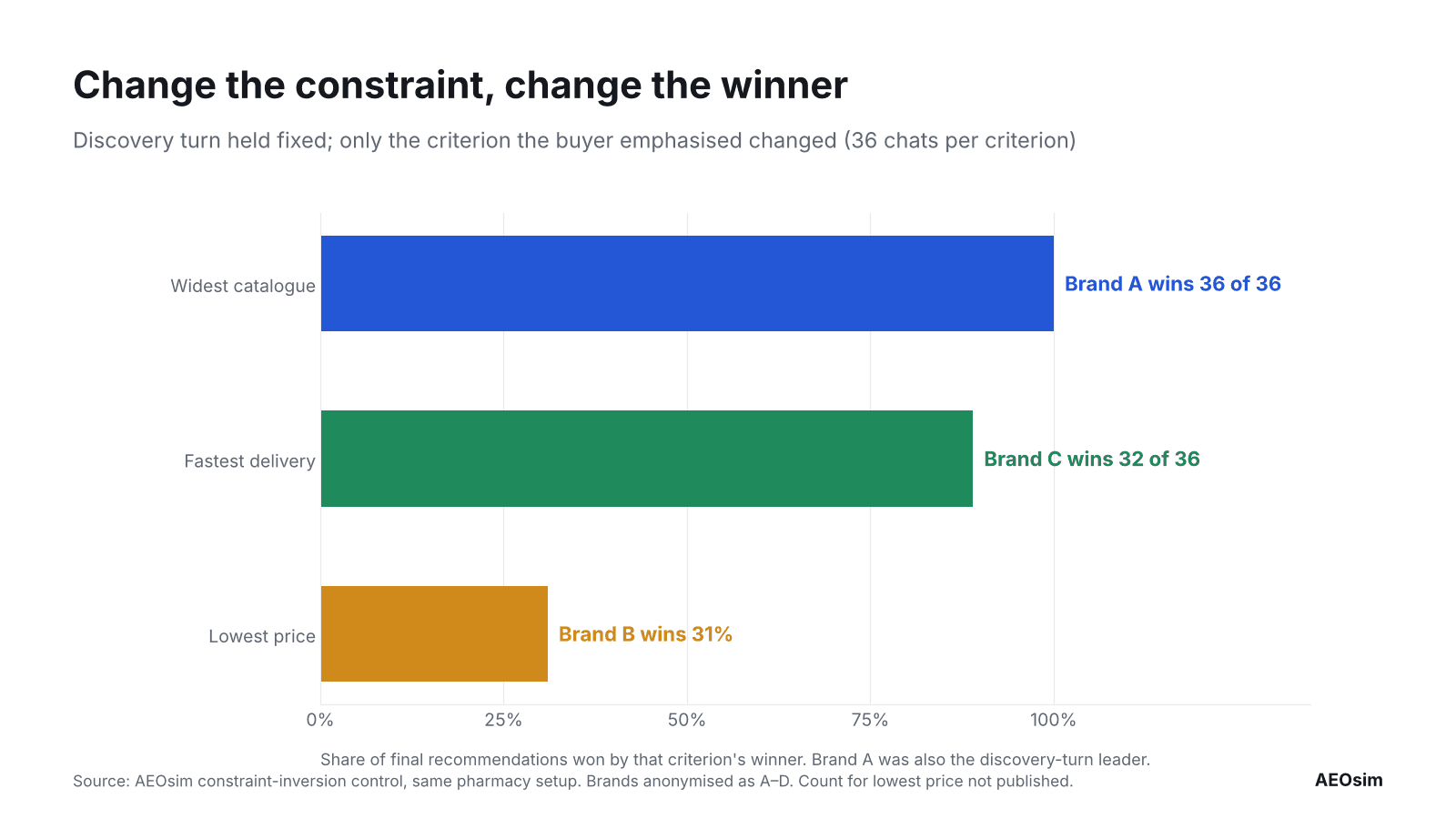
What this does and does not show. It is one engine and one category, so 9% is not a universal rate. It does show the mechanism: once a buyer states what they care about, the engine re-ranks on those criteria. Discovery visibility stops predicting the outcome at exactly the point where money is about to change hands.
The same pattern shows up outside our lab. In a NeurIPS 2025 workshop paper, He et al. found that resampling the same question moved accuracy by 0.2 to 2.8 points, while pressing across turns moved it by roughly 12. The turn axis carries several times the movement of the run axis.
Part 1: The conversation funnel
A buying chat runs through five recognisable turns, and a brand has to survive each one. The opening question records entry. The decision turn records the outcome. Everything in between is where brands are won and lost.
| Turn | What the buyer does | What the brand has to prove |
|---|---|---|
| 1. Opening | Asks a broad category question | Relevant enough to enter the set |
| 2. Comparison | Asks how options differ | A specific, comparable position |
| 3. Constraint | Adds budget, delivery, size, compliance | The claim survives the condition |
| 4. Objection | Tests evidence, trust, returns | Grounded proof, not awareness |
| 5. Pick | Asks the engine to choose | Fit for this buyer and constraint set |
Conversation drop-off is the turn where a brand leaves the recommendation set. It replaces "were we mentioned?" with "how far did we get?" A brand that drops at a price turn needs clear value evidence, not more awareness content. A brand that drops at a trust turn needs visible returns, warranty and seller information.
The chat also pre-qualifies the visitor. Across pharmacy, insurance and marketplace categories, AEOsim measured AI-referred sessions adding to cart at 2.5x to 5.1x the rate of Google-direct sessions. Later funnel steps converted at roughly equal rates. The comparison work had already happened inside the chat.
Three things make this harder in India:
- Hinglish and Indic follow-ups. Buyers switch language mid-chat, and engines handle the switch unevenly.
- INR budgets and city-tier delivery. Constraints that depend on Indian context can push an engine toward US retailers or USD pricing.
- Marketplace gravity. Amazon and Flipkart listings compete with your own PDP for the same product name.
Go deeper in this cluster:
- Why single-prompt tracking overstates your AI visibility
- The five turns of an AI shopping chat
- Conversation analytics vs prompt tracking vs GA4 referrals
Part 2: Simulating conversations you can trust
Nobody outside the AI labs has a log of what buyers type into ChatGPT. There is no Search Console for chat. So every AI visibility number rests on a simulated prompt set, and the quality of that set decides what the number can prove.
Four design choices separate a checkable simulation from a guess:
- Ground prompts in business decisions, not keywords. Templating Search Console keywords into questions gives you real keywords and invented questions. Sales call notes, support ticket categories, CRM objection fields and return reasons describe the decision a buyer is actually making.
- Treat syntheticity as a spectrum. A prompt is not simply real or fake. A verbatim sales-call question, a normalised version of it, a task-elicited prompt, a constraint template and a model-authored prompt each carry a different bias. Record where each prompt sits and which way its bias points.
- Build prompt families. One canonical task, then controlled variations: paraphrases that should not change the answer, and constraint changes that should.
- Size the sample honestly. A single AI response is one draw from a distribution. In a 50-prompt convergence study, 25 prompts had not stabilised after 20 runs. Repeated runs and confidence intervals are not optional.
There is a fifth point that surprises most buyers of these tools. The most informative prompts for your brand are the ones you win about half the time. Under item response theory, information peaks at a win probability of 0.5. Prompts you always win, and prompts you never win, tell you nothing new, however much traffic they represent.
Go deeper in this cluster:
- Building a prompt set that represents real buyers
- Syntheticity is a spectrum, not a flaw
- How many chats is enough?
- Ground prompts in business data, not GSC keywords
Part 3: Metrics beyond mentions
A mention count tells you a brand was named. It does not tell you whether the brand was picked, why it lost, or whether the result will repeat. Conversation-level measurement needs its own vocabulary.
| Metric | What it measures | The question it answers |
|---|---|---|
| Share of Recommendation | Share of chats where the brand is the final pick | Are we winning the decision, not just the mention? |
| Brand Survival Rate S(n) | Probability the brand is still recommended at turn n | How far into the chat do we last? |
| Drop rate and recovery rate | Chance of falling out, and of coming back, per turn | Is this a survival problem or a coverage problem? |
| Visibility half-life | Turns until the opening advantage halves | Is first-response monitoring worth paying for? |
| Recommendation stability | Consistency of the final pick across identical replays | Is the win real or noise? |
| Constraint map | Which buyer criteria the engine ties to each brand | Which objection is costing us the deal? |
The drop and recovery rates come from a simple two-state model (Vignesh Kanike, AEOsim). Its useful result: long-run visibility depends on the ratio of recovery to drop rate, not on first-response position. Three brands at an identical 72% first-response visibility can converge toward 18%, 39% and 65% within a few turns (an illustrative example in that post).
Two cautions belong next to any metric:
- Not every drop is the brand's fault. Some drops are justified exclusions (the buyer ruled you out). Others are the engine losing track of its own shortlist. AEOsim calls the share of genuine exclusions γ, and a low γ can reverse cross-engine rankings (third axis).
- Tools disagree for structural reasons. Probe surface, prompt set, runs per prompt, conversation turn and retrieval handling all differ between tools. Two tools can both be right about different draws from the same distribution.
Go deeper in this cluster:
Part 4: How AI engines read product pages
At the decision turn, the engine has to justify a pick, and it usually does that by retrieving a page. For ecommerce that page is most often a product page, a category page, or a marketplace listing. Which one gets pulled, and what the engine can extract from it, decides whether your brand survives the constraint.
Most PDP-for-AI advice online is a schema-and-specs checklist. Retrieval works differently:
- Pages are chunked. The engine matches passages, not whole pages. A fact buried under offer banners or inside a tab may never land in a matched chunk.
- Headings anchor chunks. A heading that mirrors how buyers phrase follow-ups ("Who it's for", "X vs Y") gives a retriever a clean target.
- Page chrome competes with product facts. Offer strips, policy widgets and repeated navigation dilute the text a retriever sees.
- Resellers compete for your own product name. An Amazon or Flipkart listing can outrank your PDP for the exact product query.
- Trust signals decide the pick. Ratings, seller identity, returns and warranty are what engines cite when asked where to buy.
Shopping surfaces are also shifting from pages to feeds. Where an engine reads a product feed instead of a page, the PDP still matters for non-Shopping chats and for everything the feed does not carry.
Go deeper in this cluster:
- Feeds vs pages: what AI shopping now reads
- Page chrome is diluting your product page
Part 5: The PDP playbook
Once measurement shows where a brand drops, the fix is usually on the page the engine retrieves at that turn. These are the levers, in rough order of effort:
- Titles that answer intent. Name the use, who it is for, and the key spec. Stop before it becomes keyword stuffing.
- Headings as retrieval anchors. "Uses of X", "Who it's for", "X vs Y" match the follow-ups buyers actually type.
- An attribute block high on the page. Size, material, compatibility, warranty, delivery: the facts a constraint turn asks about.
- FAQ built from what the AI asks. Ask an engine what it needs to know about your product, repeatedly, until the list stabilises. Answer those questions on the page.
- A visible trust block. Ratings, seller identity, returns, warranty and service network, written as text a retriever can read.
- Consistent facts across listings. Your own PDP, Shopify catalogue, Amazon, Flipkart and ONDC should agree, so engines do not pick the wrong one.
Two rules apply to every change:
- Never invent claims. Rewriting a PDP with AI is safe only from a verified fact list. Efficacy claims and fake proof are the fastest way to lose trust, with buyers and with engines.
- Test before you scale. A PDP change should be checked against held-out queries before it rolls out across the catalogue.
The detailed playbook posts in this cluster are in production. This section will link to each one as it ships.
Part 6: Agencies and operations
For SEO agencies, multi-turn AI search is a new reporting layer to add to existing retainers, not a replacement for SEO. The client question has changed from "where do we rank?" to "does the AI recommend us when a buyer is ready to choose?" Agencies that can answer the second question with numbers, every month, have a defensible upsell.
What that looks like in practice:
- A free mini-audit as the entry point. A short, fixed-scope check of how a brand fares across a handful of buying chats, which doubles as a sales conversation.
- A monthly conversation report. Share of Recommendation trend, the constraint map, and the PDP fixes shipped that month.
- A shared vocabulary. Clients need to know what drop-off, half-life and Share of Recommendation mean before they can act on them.
- A reporting cadence. Weekly for unstable categories, monthly for the trend, quarterly for strategy.
The operational trap is cost. Running multi-turn simulations properly means many replays per conversation, across engines, with extraction and calibration on top. Teams that build this in-house should price API spend, maintenance and calibration before they commit.
Go deeper in this cluster:
What to do this month
Start small. Five buying conversations measured properly tell you more than 500 single prompts.
- Write five buying conversations for your top category. Each one: an opening question, a comparison, a real constraint, an objection, and a request to pick.
- Run each one repeatedly, on at least two engines. Record which brands appear at every turn, not just the first.
- Find your drop-off turn. The first turn where you leave the set is your diagnosis.
- Open the page the engine pulled at that turn. Check whether it answers the constraint that removed you, in text a retriever can read.
- Fix one thing, then re-run the same conversations with the same settings. Compare rates, not screenshots.
Sources
- Conversation Analytics: Chat Is the New Funnel, AEOsim
- Measuring AI Search Visibility Beyond the First Response, AEOsim
- Visibility Has a Third Axis, AEOsim
- Top 7 AI Visibility and AEO/GEO Monitoring Tools in 2026, AEOsim
- Play the Games You Might Lose, AEOsim and Kojable
- Modeling and Predicting Multi-Turn Answer Instability in LLMs, He et al., 2025
Want to see where your brand drops? Get a free AI-search mini-audit across five buying chats in your category.