AEOsim blog
Multi-turn AEO glossary
Table of contents
Why this glossary exists
Multi-turn AI search needs words that single-prompt tracking never had. "Visibility" alone means five different things depending on which tool you ask. This glossary defines 30 terms used across AEOsim's research and in Analytika reports, each in one or two plain sentences, so marketers, analysts and agencies mean the same thing when they use them.
Terms are grouped into three sets: the conversation itself, how it is measured, and the prompts and pages underneath. Each definition links to the post where the term is worked through in detail.
The conversation
| Term | Definition |
|---|---|
| Conversation Analytics | Measuring how brands appear, persist, compete and get recommended across a full multi-turn AI conversation, rather than in one response. Framework originated by AEOsim (source). |
| Conversation Funnel | A buying chat read as stages a brand must survive: discovery, comparison, constraint, evaluation, recommendation, decision. |
| Turn ladder | A fixed script of buyer turns used to replay the same conversation repeatedly, for example opening, comparison, constraint, objection, pick. |
| Discovery turn | The opening, broad category question. It records entry into the conversation, not the outcome. |
| Constraint turn | A turn where the buyer adds a decision criterion such as budget, size, delivery window or compatibility. |
| Decision turn | The turn where the buyer asks the engine to choose. Also called the terminal turn. |
| Conversation drop-off | The turn or stage at which a brand leaves the recommendation set. The AI-search version of funnel abandonment. |
| Deflection | A chat that ends without naming any brand: a bundle, a substitute, "ask a professional", a refusal, or silence. |
| Terminal disposition | How a buying chat ends: a single pick, a shortlist, or a decline to choose. |
| Clarification branch | A turn where the engine asks the buyer a question. Different answers send the conversation down different branches with different brand sets (source). |
| In-play | A brand is in play at a turn if it is still in the engine's recommendation set at that turn. |
Measurement
| Term | Definition |
|---|---|
| Share of Recommendation (SoR) | The share of buying chats in which a brand is the final pick. The unit is the chat; the outcome is who gets chosen. |
| Share of voice (mention) | The share of responses that mention a brand at all. A weaker signal than SoR, because being named is not being picked. |
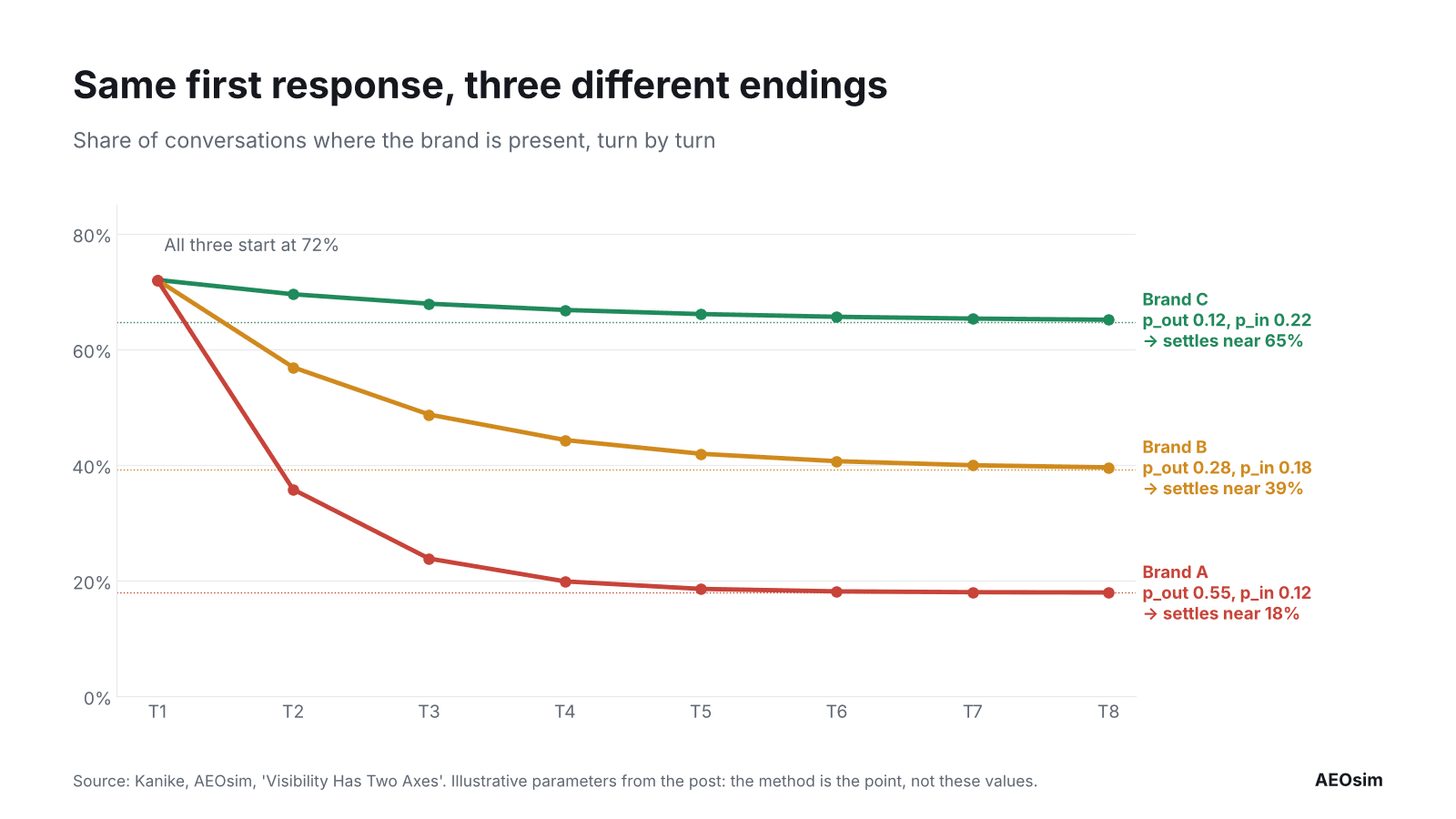
| Brand Survival Rate, S(n) | The probability that a brand is still recommended at turn n. Two brands with equal first-response visibility can have very different survival curves. |
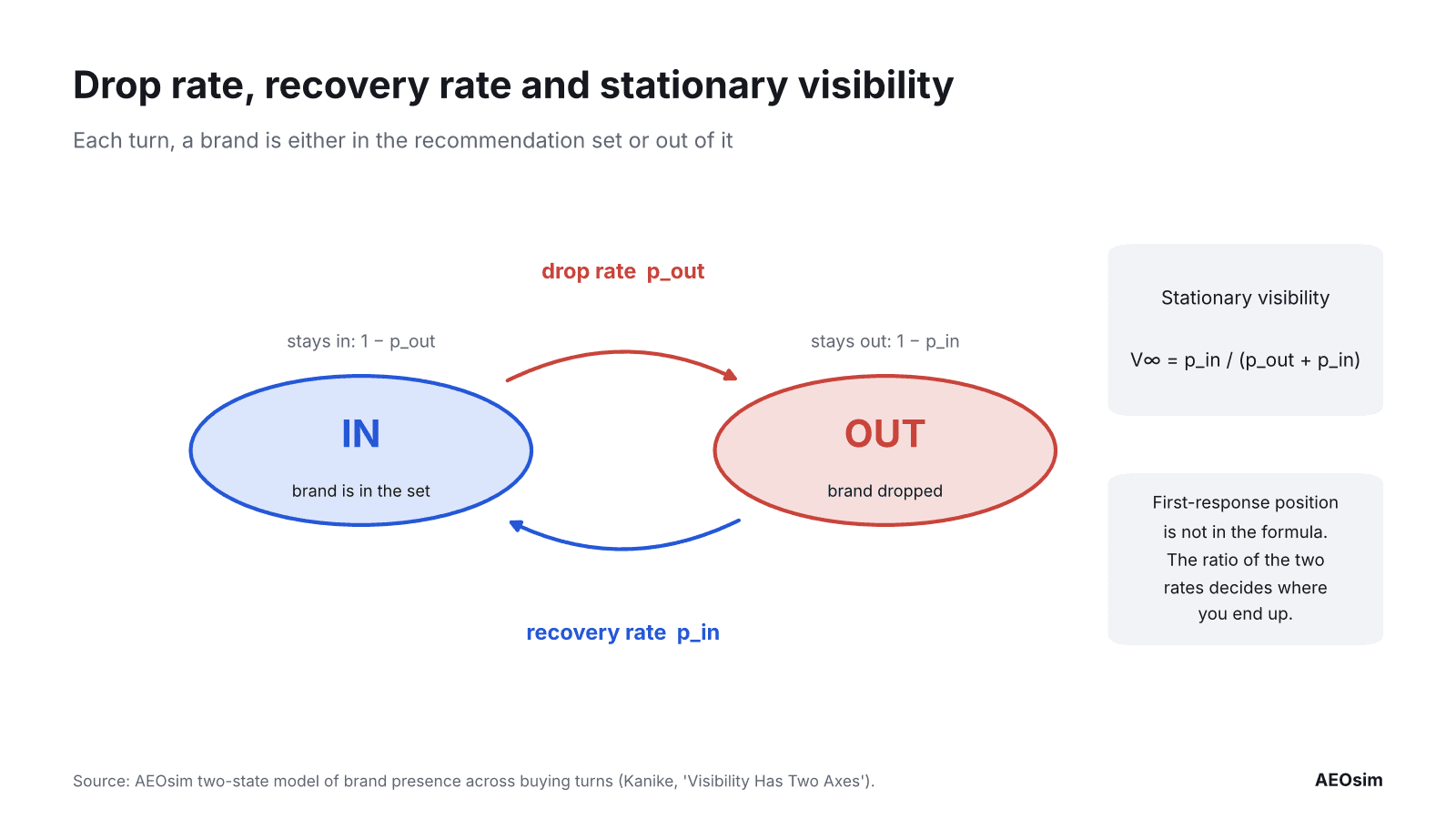
| Drop rate (p_out) | The probability a brand present at one turn is absent at the next (source). |
| Recovery rate (p_in) | The probability a brand absent at one turn is present at the next. |
| Stationary visibility (V∞) | The long-run share of turns a brand is present, equal to p_in / (p_out + p_in). It does not depend on first-response position. |
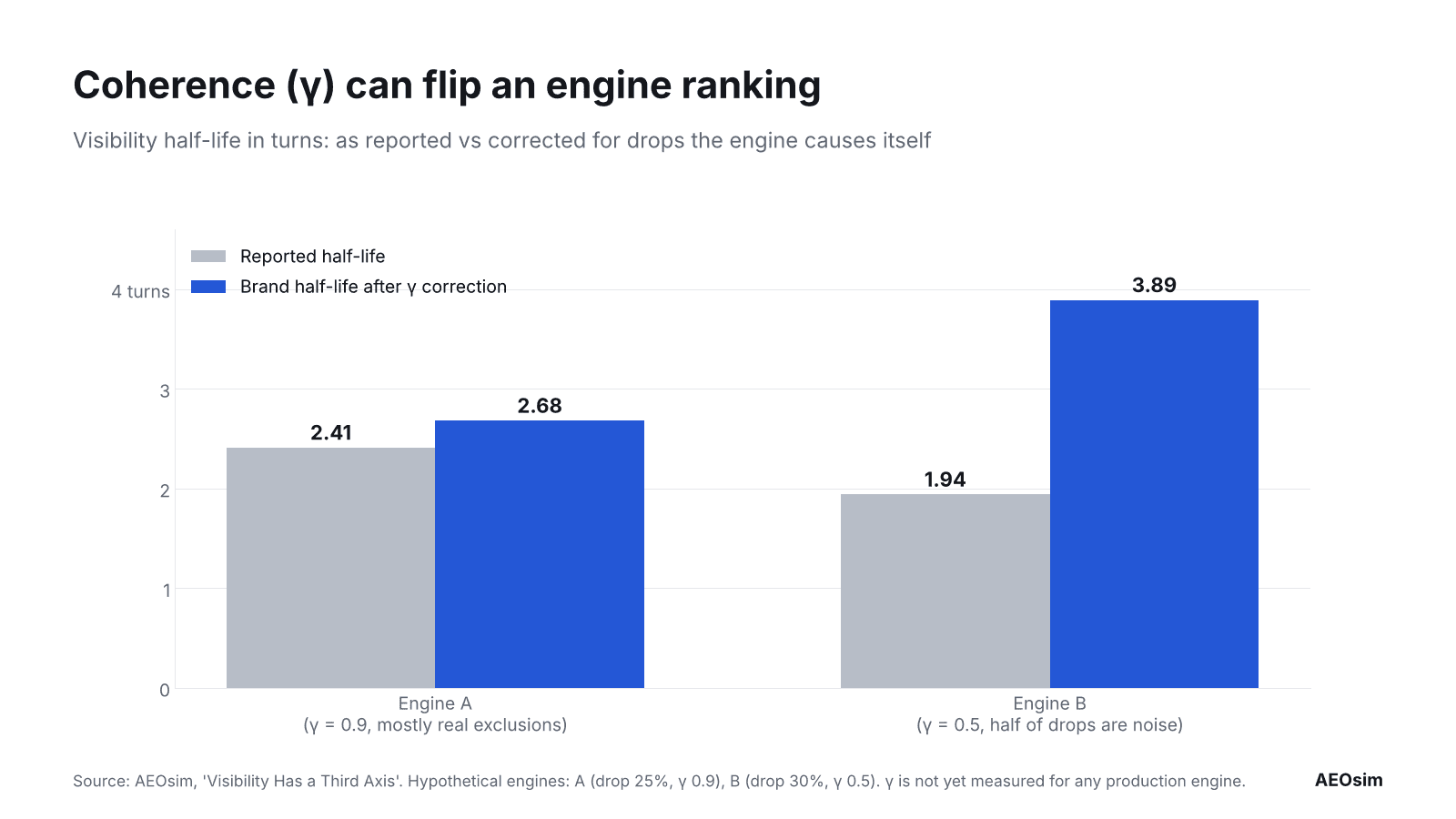
| Visibility half-life | The number of turns until a brand's opening advantage halves. A short half-life means first-turn rankings fade before the decision. |
| Coherence (γ) | The share of drops that are genuine exclusions rather than the engine losing track of its own shortlist. Low γ can reverse cross-engine rankings (source). |
| Recommendation stability | How consistent the final pick is across identical replays of the same conversation. |
| Constraint map | A view of which buying criteria an engine ties to your brand versus competitors. |
| Confidence interval (CI) | The range a reported rate plausibly sits in, given the number of runs. A rate without one is a single draw presented as a fact. |
| Convergence | The point where repeated runs of a prompt stop changing the measured brand distribution. Many prompts need 15 or more runs (source). |
Prompts, retrieval and pages
| Term | Definition |
|---|---|
| Syntheticity | How far a prompt's generating process is from real buyer behaviour. A spectrum from verbatim sales-call questions to model-authored prompts, not a real-or-fake label (source). |
| Prompt family | One canonical buying task plus controlled variations: paraphrases that should not change the answer, and constraint changes that should. |
| Branded vs unbranded prompt | A branded prompt names your brand; an unbranded one asks about the category. They diagnose different problems and should be scored separately. |
| Prompt discrimination | How sharply a prompt separates strong brands from weak ones. Prompts a brand wins about half the time carry the most information (source). |
| Anchor prompts | A fixed block of prompts kept across measurement cycles so results stay comparable when the rest of the set is refreshed. |
| Probe surface | Which version of an engine a tool queries: the raw API, the logged-out app, or the logged-in app. Each can return different answers. |
| Retrieval eligibility | Whether a page can be fetched, chunked and matched at all when an engine searches the web to answer a turn. |
Related reading: Chat Is the New Funnel · Inside a free AI-search mini-audit · Why AI visibility tools disagree
See these metrics on your own category. Book an Analytika demo.