AEOsim Blog
Top 7 AI Visibility and AEO/GEO Monitoring Tools in 2026: A 17-point comparison across measurement integrity, prompt intelligence, setup, and ROI
Table of Contents
Quick Comparison: All 7 Tools at a Glance
Fit-scores out of 100 against the 17-criterion rubric in Q2 (12 measurement criteria worth 70 points, 5 operational-fit criteria worth 30 points), computed from public pages and named third-party reviews as of July 8, 2026. A high score means strong alignment with measurement integrity and reasonable operational fit, not that a tool is universally better for every buyer: a content suite and a measurement layer solve different jobs. Starting price is each vendor's published lowest paid tier; feature scope at that price varies sharply across tools, which the operational-fit criteria in Q2 account for.
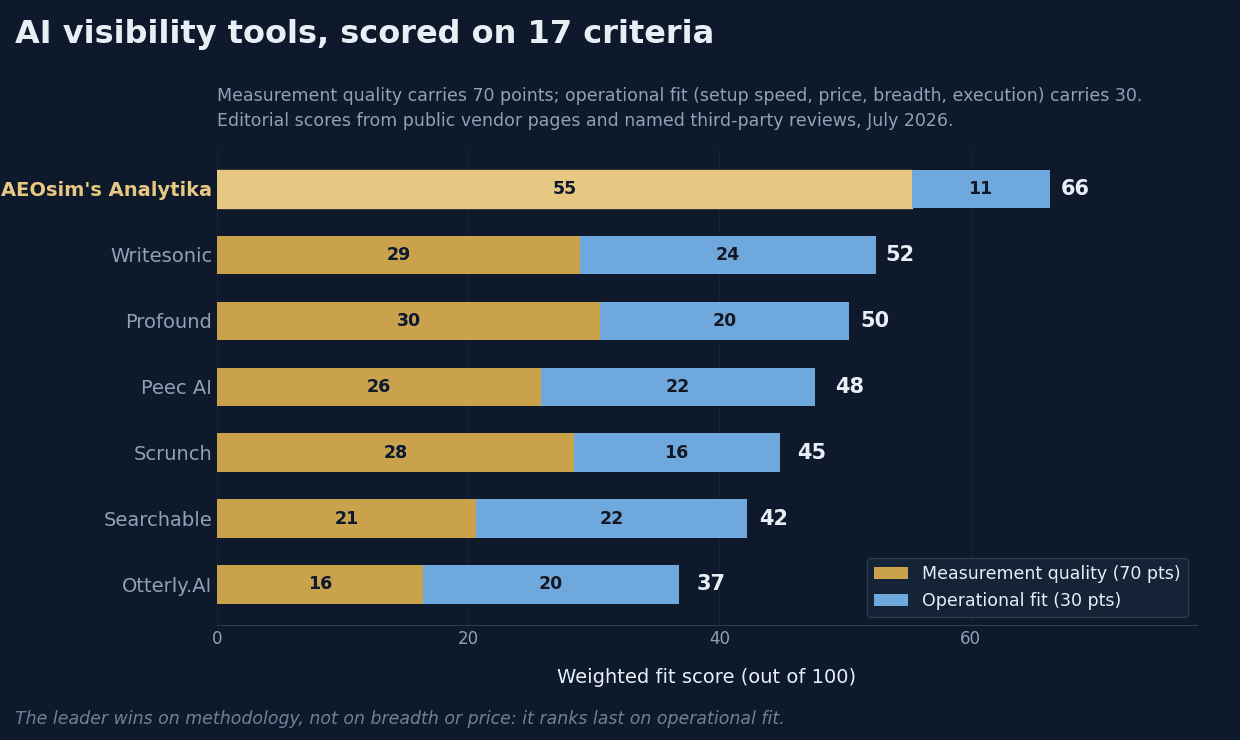
| Rank | Tool | Fit score /100 | Starting price/mo | Best for | Main limitation to validate |
|---|---|---|---|---|---|
| 1 | Analytika | 66 | $200 | Funded scale-ups and enterprises in finance, healthcare, travel, edtech, used goods, and B2B SaaS that need decision-grade measurement | Enterprise/custom BI setup takes longer; narrower sector and engine coverage than the broadest platforms; no in-built content execution (optional add-on) |
| 2 | Writesonic | 52 | $79 | Content teams that want tracking, Cloudflare crawler analytics, and content fixes in one suite | Undisclosed probe methodology (API vs UI, dataset provenance); verify in demo |
| 3 | Profound | 50 | $99 | US enterprise brands that want real prompt demand data (Prompt Volumes) and board-grade reporting | Meaningful features reportedly gate at higher tiers; verify run methodology and surface probed |
| 4 | Peec AI | 48 | $95 | Agencies and lean teams that want clean multi-engine monitoring with UI-scraped data and unlimited seats | 1 credit = 1 prompt x 1 model x 1 day: single-run daily sampling; per-model add-ons raise real cost |
| 5 | Scrunch | 45 | $250 | Enterprises and agencies needing the broadest engine coverage, persona filtering, and AI-referral traffic attribution | Prompt refresh frequency undisclosed; labor-intensive setup where bad default prompts produce misleading numbers |
| 6 | Searchable | 42 | $125 | Teams that want monitoring plus AI-article production and site audits in one mid-priced plan | 9,000 answers/mo on 100 prompts x 3 engines pencils to 1 run per prompt per day; no stated variance handling |
| 7 | Otterly.AI | 37 | $29 | Solo founders and very small teams that want the cheapest possible mention tracking | Positions UI-style result snapshots; validate in demo which surface is actually probed and how often |
Q1. What kinds of AI visibility tools are in this comparison?
All 7 tools answer the same question, how visible is a brand inside AI answers, but they reached that question from different starting points, and the starting point determines what each one measures well. Grouping by architecture rather than by marketing category makes the tradeoffs legible: what a tool was built to do cheaply is usually what it does best, and what it was never built to do is usually missing from its dashboard.
| Archetype | Tools in this comparison | The job it is built for | What it structurally does poorly |
|---|---|---|---|
| Measurement-first analytics | Analytika | Decision-grade measurement tied to pipeline value | No in-built content execution; enterprise/custom BI integrations take longer than plug-and-play monitors |
| Enterprise visibility platform | Profound, Scrunch | Broad engine coverage, stakeholder reporting, traffic attribution | Sampling methodology rarely disclosed; no multi-turn measurement |
| Self-serve monitoring | Peec AI, Searchable, Otterly.AI | Affordable mention and citation tracking across engines | Statistical confidence, persona depth, ROI attribution |
| Monitoring inside a content suite | Writesonic | Turning visibility gaps into shipped content quickly | Neutrally measuring the effect of the content it just shipped |
Since measurement rigour and decision-grade analytics gets 70% of the rubric, a content-led team may rationally buy the tool ranked fourth here, and Q6 routes those buyers by situation rather than by score.
Q2. How were these 7 tools scored? Methodology, weights, and guardrails
Every tool was scored 1-10 on 17 criteria across two blocks, each criterion has a weight, weights sum to 100, and the fit score is the weighted average. The first block, 12 criteria worth 70 points, measures methodology quality: the failure modes in Q3. The second block, 5 criteria worth 30 points, measures operational fit: the practical costs and constraints of actually buying and running each tool, independent of how rigorous its methodology is.
A tool can be methodologically strong and still be the wrong buy for a given team on speed, price, or breadth. Sources are each vendor's public pricing and product pages plus named third-party reviews, all as of July 8, 2026.
Block A: Measurement quality (70 points)
| # | Criterion | Weight | What was checked |
|---|---|---|---|
| 1 | Measurement surface integrity | 9 | Does the tool state whether it probes the API, the logged-out UI, or calibrates between surfaces? Is there any correction method for the surfaces it does not probe? |
| 2 | Statistical rigor | 9 | Repeated runs per prompt, variance or confidence-interval reporting, convergence-aware run budgets rather than fixed single-run daily sampling |
| 3 | Prompt intelligence methodology | 7 | A stated data-to-prompts pipeline versus hand-written prompts or naive LLM expansion from seed keywords |
| 4 | Multi-turn conversation mapping | 7 | Any measurement of brand entry, survival, and exit across a multi-turn buying conversation, versus turn-one snapshots |
| 5 | Prompt data sources | 6 | What feeds the prompt set: business intelligence, real demand data, GSC keywords, or user guesswork |
| 6 | Personas and persona divergence | 6 | ICP-derived personas with visibility broken out per persona, not one generic asker |
| 7 | ROI-EV mapping | 5 | Visibility expressed as pipeline exposure in currency with expected-value ranges, usable for prioritization |
| 8 | Actionable insights with justified ROI | 5 | Recommendations ranked by expected impact with the reasoning shown, not generic tips |
| 9 | Geography fidelity | 4 | Regional probing that actually changes the retrieval context, versus a location parameter that may not |
| 10 | Latent authority estimation | 4 | Any attempt to separate parametric brand association (baked into model weights) from retrieval-induced mentions |
| 11 | Sentiment fit for LLM answers | 4 | Sentiment methodology built for hedged, comparative AI answers versus legacy social-listening NLP |
| 12 | Crawl-log grounding | 4 | Joining AI crawler behavior from server or CDN logs to citation outcomes |
Block B: Operational fit (30 points)
| # | Criterion | Weight | What was checked |
|---|---|---|---|
| 13 | Setup speed | 8 | Time from signup to first usable report: minutes, hours, or days, and what drives the difference |
| 14 | Entry-price affordability | 8 | Published starting price only, scored relative to the full 7-tool range in this comparison ($29-$250) |
| 15 | Sector and market agnosticity | 6 | Whether the tool is built for one geography or vertical set versus broadly applicable out of the box |
| 16 | Engine and language coverage | 4 | Number of AI engines and languages supported at the entry and mid tiers, not just enterprise |
| 17 | Execution and content support | 4 | Whether the tool ships fixes (content, technical) itself, versus measurement only |
A tool built for depth in a narrow lane, Analytika included, will not top Block B, and a tool built for broad, fast, cheap coverage will not top Block A. The 70/30 split prioritizes methodology without ignoring operational reality; the per-criterion scores in Q5 let you reweight for your own priorities.
Alongside the weights, 8 numeric guardrails set minimum evidence standards you can reuse in your own evaluation.
| Guardrail | Threshold |
|---|---|
| Runs before trusting a mention rate on a contested prompt | 20 (half of prompts in the convergence study were still moving at 20) |
| Surfaces checked per prompt before trusting a trend line | 3: API, logged-out UI, logged-in UI |
| Buyer-verbatim prompts compared against tool-generated prompts | 5 vs 5, run 10x each |
| Turns scripted per persona for journey measurement | 3 minimum: discover, constrain, compare |
| Personas per category before calling coverage adequate | 3 or more |
| Crawl-log window joined against citation data | 30 days |
| Branded vs unbranded prompt mix | Disclosed and scored separately, always |
| Proof-of-concept window before an annual commitment | 2 weeks with your own prompts, not the vendor's |
Q3. What measurement failure modes does the rubric encode?
The 12 criteria are compressed versions of failure modes measured directly, published on, or repeatedly found in client diagnostics. The short version of each, with the evidence:
Surface divergence. There is no single “ChatGPT”: the raw API, the logged-out UI, and the logged-in UI (memory, custom instructions) return different answers, and real buyers live in the third while most tools probe the first. The workable fix is hybrid calibration: dense API probes at frequency F corrected by sparse computer-use-agent UI probes at frequency f, where f is much smaller than F.
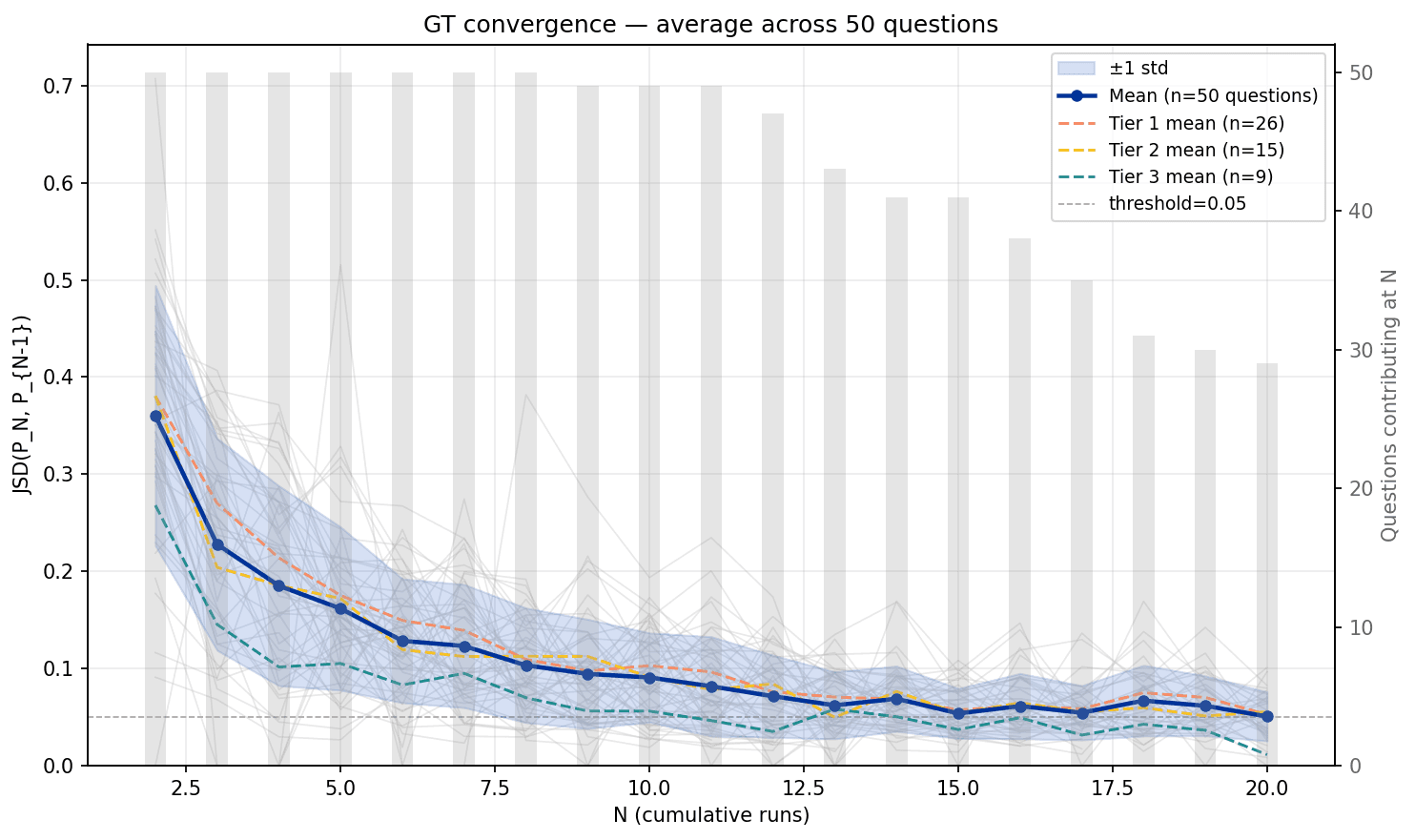
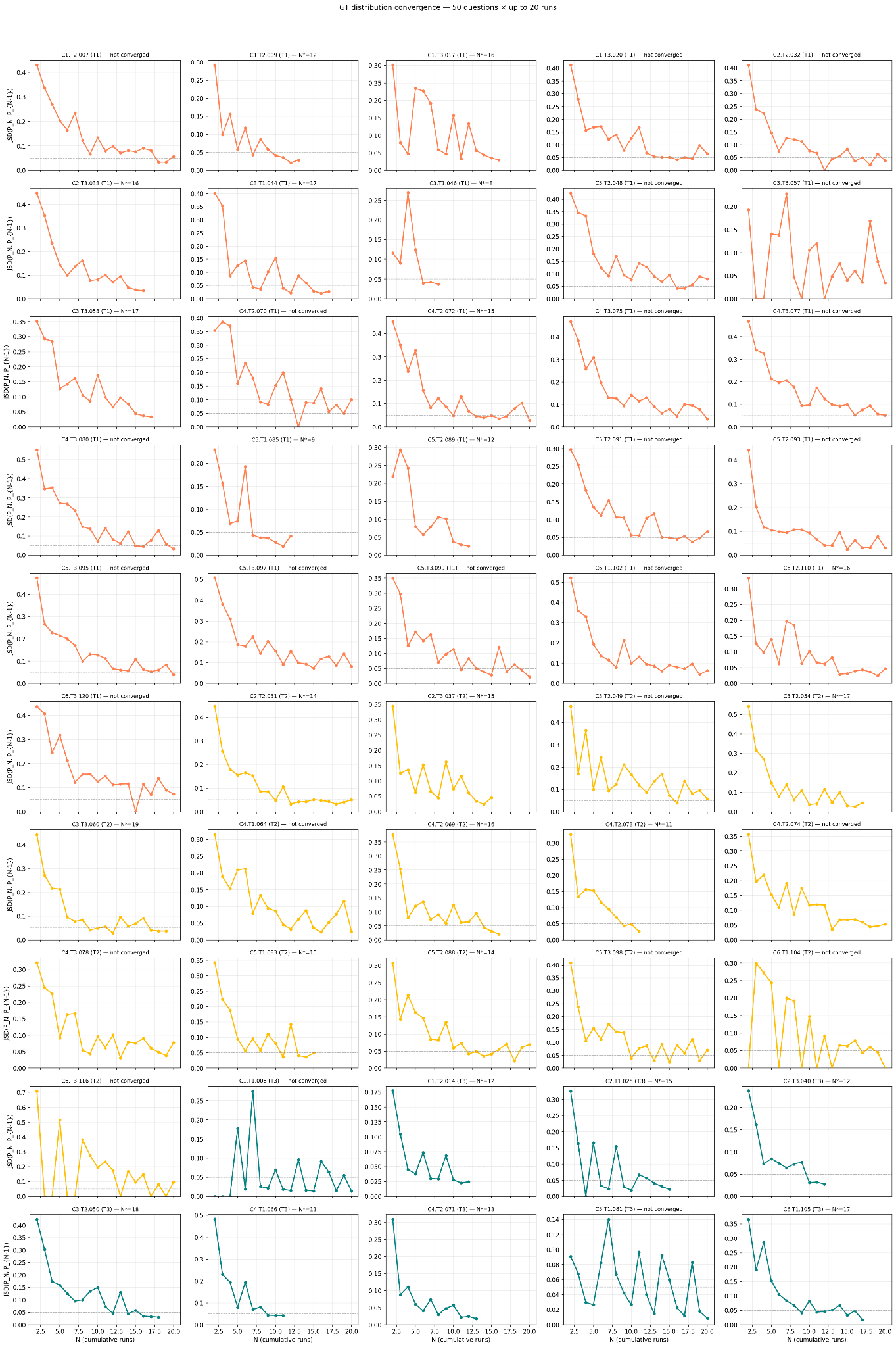
Stochasticity. A single AI response is one draw from a distribution. In a 50-prompt convergence study run on the Gemini API for this comparison, 25 of 50 prompts had not stabilized after 20 runs (JSD stability threshold 0.05, adaptive cap), the fastest stabilized at 8 runs, and prompts that never settled averaged roughly 13 cited sources per response versus roughly 8 for those that did. Peec's own research team reached compatible conclusions on wording sensitivity in their SSRN working paper and 37,804-response analysis; the gap is that products in this market still mostly sample once per day.
Prompt intelligence. Most tools generate prompts from seed keywords or let users hand-write them. Research such as the Role-Augmented Intent-Driven G-SEO paper (arXiv:2508.11158) and the hidden intent map behind AI search shows intent and persona modeling materially change visibility results. The fix is a data-to-prompts pipeline fed by BI: sales transcripts, support tickets, CRM notes, on-site search.
Multi-turn myopia. Buying happens across discover, shortlist, compare, and validate turns inside one conversation, with a decision moment and a handoff turn that land at different positions per persona. Turn-one mention rate misses all of it. The fix is journey simulation grounded in BI proxy data.
Branded vs unbranded conflation. A branded-query failure (reputation, sentiment, eligibility) and an unbranded failure (competitive visibility) point at opposite root causes; blending them into one score, or letting branded prompts inflate the average, makes reports unactionable.
Geography. Setting a location parameter does not guarantee the retrieval context of a user in Delhi or Dallas; regional fidelity needs probing infrastructure, not a dropdown.
Latent authority. A mention can come from model weights (parametric association) or from live retrieval; the optimization lever is completely different for each, and estimating the parametric layer at scale is an open problem short of mechanistic interpretability for black-box models, which is why no tool in this comparison, Analytika included, scores above 7 here.
Sentiment. Most tools inherit sentiment scoring from social-listening NLP built for short subjective posts; AI answers are hedged, comparative, and structured, and misreading them misprices reputation risk.
Crawl-log grounding. Log-file analysis for AI bots is documented practice; joining crawl behavior to citation outcomes separates extraction failures (crawled, never cited) from memory effects (cited, never crawled). Few products ship the join.
ROI-EV and actionability. A CMO cannot budget against a mention percentage. Visibility needs converting to pipeline exposure in currency ranges, and recommendations need expected-value justification, which requires most of the above to work first.
Answer composition and freshness matter too: being mentioned is the weakest visibility state, with cited authority (mentioned, cited, and present in the cited source) the strongest, and frameworks like Within-Site Utilization and content freshness belong in any complete stack. These fold into criteria 8 and 12 rather than being scored separately.
Q4. Which sectors have the highest AI search exposure for inbound leads?
AI Search exposure and urgency varies by sector. Exposure is scored using 4 factors: consideration complexity (variables a buyer has to weigh), stakes (cost of wrong decision), information asymmetry (how much the buyer has to learn to trust a claim), and existing digital-research habit (whether buyers already research this category before acting). A category high on all 4 sends buyers into multi-turn AI conversations by default.
| Sector | AI Search Exposure Index (1-10) | Primary driver | AEOsim focus |
|---|---|---|---|
| Wealth management and investing platforms | 9 | High stakes, high information asymmetry, comparison-heavy | Yes |
| Insurance (health, life, general) | 9 | Complex products, high stakes, comparison-heavy | Yes |
| Healthcare and pharma (patient-facing) | 8 | High stakes, trust-critical, symptom-to-solution research | Yes |
| B2B SaaS and enterprise software | 8 | Long consideration cycles, multi-stakeholder research, high deal size | Yes |
| Travel (complex or high-value trips) | 8 | High ticket, multi-stop planning, comparison-heavy | Yes |
| Second-hand cars and electronics marketplaces | 7 | High information asymmetry, trust and verification-heavy | Yes |
| Edtech and higher education | 7 | High stakes, long consideration, comparison-heavy | Yes |
| Legal services | 6 | High stakes and information asymmetry, low purchase frequency | No |
| Residential real estate | 6 | High stakes, but still agent and portal-driven; AI-search share is growing | No |
| New consumer electronics (laptops, phones) | 6 | Comparison-heavy, but well-served by an existing review ecosystem | No |
| New automotive | 5 | High ticket, but historically dealership and OEM-site driven | No |
| Home services and renovation | 5 | High stakes, but hyperlocal and map-and-review driven more than chat | No |
| Fashion and apparel | 3 | Low information asymmetry, visual and impulse-driven | No |
| Grocery and FMCG | 2 | Low consideration, habitual, price-driven | No |
A stochastic, single-run, turn-one snapshot is most misleading precisely where buyers are having the longest, highest-stakes AI conversations. Before investing in AI visibility work: score your own category against the 4 factors above. Above 7, wrong measurement is actively costing inbound leads today. Below 4, AI visibility work is closer to future-proofing than an urgent fix.
Sector-agnostic platforms in this comparison are built to span the whole index rather than concentrate at the top of it, which is a real advantage if your business spans many categories and a real inefficiency if it does not. The tool reviews in Q5 flag this tradeoff.
Q5. How does each tool score? Tool-by-tool review
1. Analytika: best for decision-grade measurement in Indian enterprise sectors (66/100)
Analytika is AEOsim's measurement-first AI visibility platform: Monte Carlo sampling with convergence-aware run budgets and confidence intervals, hybrid API + calibrated UI probing, BI-derived prompt intelligence with persona breakouts, multi-turn journey mapping, branded and unbranded prompts scored separately, crawl-log joins, and visibility expressed as estimated pipeline exposure in rupee or dollar ranges. Pricing starts at $200/mo. Custom enterprise engagements include BI integration for prompt generation at catalog scale, which is how intent space gets covered for unicorns and publicly listed companies with tens of thousands of SKUs. 5 out of 6 other tools here start below $200, so that entry point is a real tradeoff. See Q10 for who should not choose AEOsim.
| Fit area | Strength | Limitation to validate |
|---|---|---|
| Statistical rigor | Convergence-tested run budgets; CI on every reported share (9/10) | Run budgets raise probe cost versus single-run tools; confirm quota fit for your prompt count |
| Prompt intelligence | BI-to-prompts pipeline, personas, branded/unbranded split (9/10) | Full BI-integrated prompt intelligence on enterprise/custom plans takes 1-2 days; self-serve is faster |
| Multi-turn and surfaces | Journey simulation (8/10); hybrid UI calibration (8/10) | UI calibration runs at sparse frequency by design; confirm cadence matches your reporting needs |
| Sentiment and latent authority | LLM-native sentiment (5/10, improving); parametric vs retrieval split (7/10) | Latent authority estimation is bounded by black-box interpretability limits industry-wide |
| Geography | Region-controlled probing for India and US markets (6/10) | Broader multi-country coverage is custom-scope; verify your markets |
| Operational fit | Six sectors covered deeply, with persona and consideration-cycle templates prebuilt | 2nd-highest starting price at $200 (4/10); self-serve is quick, but enterprise/custom BI setup is 1-2 days (5/10); sector and engine breadth narrower than the broadest platforms (3/10, 5/10); no content execution shipped (2/10) |
Best-fit buyer:
Funded Indian scale-up or enterprise ($50M+ valuation or 8-figure revenue) in finance/fintech/insurance, healthcare/pharma, travel, edtech, second-hand cars and electronics, or B2B SaaS with $5M+ annual revenue: the top sectors on the AI Search Exposure Index in Q4.
Has a trackable inbound funnel and accessible BI, and can assign at least 1 full-time specialist to own the channel.
Needs numbers a CFO will accept: confidence intervals and pipeline exposure, not a single-run visibility score.
Checks to run in a demo: ask to see the convergence curve behind any reported share; ask for the branded vs unbranded split on your own category; ask how the UI calibration sample was drawn for your market.
Choose Analytika if measurement quality is the bottleneck and the buyer operates in its focus sectors and geography. Choose a competitor if sub-$200 pricing, a done-for-you service, or avoiding an enterprise/custom BI integration window matters more: Q10 names which one.
2. Writesonic: best for content teams that want tracking and fixes in one suite (52/100)
Writesonic came to GEO from content generation and its pitch is the closed loop: see the gap, ship the fix, measure the lift. Its differentiators against this rubric are Cloudflare-based AI crawler analytics (7/10 on crawl-log grounding, the highest competitor score on that criterion) and an Action Center that ranks fixes by impact (7/10 actionability). It claims 10+ platforms and location-based prompt tracking at higher tiers. Independent reviews and agency deep-dives flag that the probe methodology is not disclosed (API vs UI handling, dataset provenance for its conversation corpus), pricing starts at $79/mo per third-party-cited figures, with GEO features reportedly gated at higher tiers, and monitoring-only buyers may pay for content credits they will not use.
| Fit area | Strength | Limitation to validate |
|---|---|---|
| Crawl analytics | Cloudflare-based AI bot tracking (7/10) | Confirm log retention and export |
| Actionability | Action Center ranked fixes (7/10) | Verify the ROI reasoning behind rankings |
| Measurement core | Sentiment, branded/unbranded breakdown shown on product pages | Undisclosed run counts and probe surface; single-run daily sampling assumed until shown otherwise |
| Operational fit | Lowest starting price among the top-4 at $79/mo (9/10); broad sector reach (8/10); 10+ engines claimed (8/10); strongest content execution in this comparison (9/10) | Setup moderate (6/10): full GEO configuration takes more than a signup |
Best-fit buyer: a content-led team already producing at volume that wants tracking, technical fixes, and creation in one subscription.
Checks to run: which surface is probed and how many runs per prompt; what exactly feeds the conversation dataset; effective price for monitoring-only use.
Choose Writesonic if shipping content fixes fast matters more than measurement precision. Choose AEOsim if the numbers must survive a CFO's scrutiny before spend is allocated.
3. Profound: best for US enterprise reporting and real prompt demand data (50/100)
Profound is the best-funded platform in the category ($155M raised, $1B valuation per third-party reporting) and its standout asset is Prompt Volumes: panel-derived data on what people actually ask answer engines, which no other tool here offers and which earns it the top prompt-data-source score among competitors (7/10). Agent Analytics adds AI crawler behavior reporting (6/10 on crawl-log grounding). The gaps against this rubric: no disclosed multi-run sampling methodology or confidence reporting, no multi-turn measurement, and independent reviews note persona-based tracking and full platform coverage gate at enterprise, with entry pricing starting at $99/mo for a ChatGPT-only tier and meaningful functionality reportedly gated at higher tiers.
| Fit area | Strength | Limitation to validate |
|---|---|---|
| Prompt data | Prompt Volumes real demand panel (7/10) | Demand data tells you what the population asks, not your buyers; persona tracking is enterprise-only |
| Reporting | Board-grade dashboards, SOC 2, enterprise integrations | Sampling methodology and probe surface not disclosed on public pages |
| Crawl side | Agent Analytics crawler reporting (6/10) | Verify bot-level detail, exports, and retention per reviewer guidance |
| Operational fit | Broadest sector agnosticity in this comparison (9/10); reasonably fast self-serve signup (7/10) | Starting price $99 is mid-pack (7/10); engine coverage gates hard at entry, ChatGPT-only (4/10); no content execution (2/10) |
Best-fit buyer: US-centric enterprise with board-level AI visibility reporting needs and a research use for demand-volume data. Its sector reach spans the full AI Search Exposure Index in Q4 rather than concentrating at the top of it, which suits a brand portfolio spanning many categories more than a single high-exposure vertical.
Checks to run: how many runs per prompt per day, and is variance reported; which surface (API or UI) produced the dashboard; what does persona tracking cost at your tier.
Choose Profound if demand panel data and stakeholder reporting are the job. Choose Analytika if statistical confidence, multi-turn journeys, or India-market fidelity matter more.
4. Peec AI: best for lean multi-engine monitoring with UI-scraped data (48/100)
Peec AI (Berlin, 2,000+ teams per third-party coverage) is the most methodologically self-aware of the self-serve monitors: its research team published the strongest public work on prompt-wording sensitivity, and reviewers confirm it queries assistants by simulating real browser sessions rather than calling APIs, earning the top competitor score on surface integrity (7/10). The product gap is sampling: the credit system defines 1 credit as 1 prompt x 1 model x 1 day, single-run daily sampling with no variance reporting (4/10 statistical rigor), and reviews note no traffic or lead attribution, no multi-turn, and per-model add-ons that raise real multi-engine cost above the $95 starting price.
| Fit area | Strength | Limitation to validate |
|---|---|---|
| Surface | Browser-session scraping of real UIs (7/10) | Logged-out sessions only: no personalization layer |
| Usability | Unlimited seats, clean setup, sentiment bundled mid-tier | Claude and newest engines gate at Enterprise |
| Rigor | Best public research in the segment | Product samples once per prompt per day; research rigor has not shipped into the product |
| Operational fit | Fastest self-serve setup in this comparison (9/10); starting price $95 is affordable (8/10); broad, agency-friendly sector reach (9/10) | No content execution shipped (1/10); engine coverage limited before add-ons (6/10) |
Best-fit buyer: agencies and lean in-house teams tracking multiple brands who value UI-accurate snapshots and seat economics over statistical depth. Like Profound, its client base spans the AI Search Exposure Index broadly rather than concentrating in the highest-exposure sectors, which fits an agency book of business better than a single vertical operator.
Checks to run: ask for run-to-run variance on one contested prompt; total cost with your full engine list; branded vs unbranded split.
Choose Peec if affordable self-serve monitoring with UI-accurate snapshots is the priority. Choose Analytika if single-run daily sampling is the failure mode being escaped.
5. Scrunch: best for enterprise engine coverage and AI-referral attribution (45/100)
Scrunch ($15M Series A, 500+ brands per agency reviews) offers the broadest engine coverage in this comparison, tracking ChatGPT, Gemini, Perplexity, Claude, Meta AI, Google AI Mode, and AI Overviews, with SOC 2 and white-glove onboarding. Two genuine differentiators against this rubric: persona and funnel-stage filtering built into the prompt model, which earns the top competitor score on personas (7/10), and an agent-traffic layer combining GA4 AI-referral attribution, bot-traffic reporting, and site maps (7/10 crawl-log grounding). Peec AI cautions are sampling and setup. Competitor-published review reports the prompt refresh frequency is undisclosed, with first-hand experience suggesting weekly rather than daily updates, and no variance reporting appears anywhere (3/10 statistical rigor). An independent agency review that purchased a month of the Agency plan flags a labor-intensive setup in which poorly matched default prompts produced a misleading 1% citation rate for a client, which is exactly the prompt-provenance failure described in Q3.
| Fit area | Strength | Limitation to validate |
|---|---|---|
| Personas | Persona and funnel-stage filtering built into tracking (7/10) | Three personas at the starting tier; confirm your segment count |
| Agent traffic | GA4 AI-referral attribution, bot traffic, site maps (7/10) | Attribution is referral-based, so uncited and dark AI traffic stays unmeasured |
| Engine coverage | Seven engines including Claude, Meta AI, and Google AI Mode (9/10) | Prompt credits deplete across engines; confirm effective coverage at your prompt count |
| Rigor | Prompt-level reporting, sentiment, competitor share of voice | Refresh frequency undisclosed and no variance reporting; Insights and Site Audits reported as beta |
| Operational fit | Broad sector reach (8/10); AXP and page optimizations ship some execution (6/10) | Second-highest starting price at $250 (3/10); labor-intensive setup (4/10) |
Best-fit buyer: an enterprise or agency that needs maximum engine coverage, persona-level breakdowns, and referral-traffic attribution, and has the internal patience to configure the prompt set properly rather than accepting defaults. Its client base spans the AI Search Exposure Index in Q4 broadly, from technology and retail to healthcare and financial services.
Checks to run: how often each prompt refreshes, and whether any prompt runs more than once per refresh; who configures the default prompt set and how it gets validated against your actual buyers; which Insights and Site Audit features are out of beta today.
Choose Scrunch if engine breadth, persona filtering, and GA4 attribution matter most. Choose AEOsim if the sampling behind those persona numbers has to be defensible.
6. Searchable: best for monitoring plus content production on a budget (42/100)
Searchable bundles tracking with AI-article generation and technical site audits: the $125/mo entry covers 100 prompts across ChatGPT, Google AI Overviews, and Perplexity with roughly 9,000 answers analyzed monthly, plus 20 articles and 200 site audits, and a mid tier at 500 prompts with white-label reporting. The arithmetic: 100 prompts x 3 engines x 30 days is 9,000 answers, one run per prompt per engine per day, with no stated variance handling, no multi-turn, and no crawl-log join on public pages. As a value bundle for a small team it is coherent; as measurement it inherits all single-run failure modes in Q3.
| Fit area | Strength | Limitation to validate |
|---|---|---|
| Bundle value | Monitoring + 20 articles + audits at $125 | Content quality and citation-worthiness of generated articles |
| Coverage | Claude/Copilot/Grok/DeepSeek at Enterprise | Entry tiers are 3 engines |
| Rigor | Daily cadence, exportable reports | Single-run sampling by arithmetic; confirm any repeat-run option |
| Operational fit | Fast setup (8/10); bundles execution in (7/10) | Starting price $125 is mid-pack (7/10); entry-tier engine coverage limited to 3 (5/10) |
Best-fit buyer: a small marketing team that wants one affordable subscription for tracking, content, and audits, and accepts directional numbers.
Checks to run: can any prompt be run more than once per day; how are branded prompts weighted in the visibility score; sample generated article on your topic.
Choose Searchable if budget forces one tool for three jobs. Choose Analytika if the measurement half of that bundle has to be trustworthy on its own.
7. Otterly.AI: best for the cheapest possible entry into mention tracking (37/100)
Otterly.AI is the budget anchor of the category: a $29/mo starting plan across 4 engines, monitoring-only, and reviews position it as the affordable entry point. Its marketing emphasizes result snapshots resembling what users see; a first-hand look at the product earlier this year found snapshots that resembled API responses rather than captured UI sessions, so surface integrity is scored conservatively (3/10), with a recommendation to validate the probe surface directly in a demo. At entry-tier prompt volume and single-run cadence, statistical and persona depth are out of scope by design.
| Fit area | Strength | Limitation to validate |
|---|---|---|
| Price | Lowest starting price in this comparison at $29 | Entry-tier prompt quota is a toy-scale sample for any real catalog |
| Simplicity | Fast setup, simple reports | Probe surface: confirm UI vs API in demo |
| Depth | Multi-country options cited on higher plans | No variance, personas, multi-turn, or ROI features on public pages |
| Operational fit | Cheapest starting price in this comparison (10/10); fastest, simplest setup (8/10); broad generic applicability (6/10) | No content execution (1/10); prompt quota and engine depth thin past entry (5/10) |
Best-fit buyer: a solo founder or micro-team that wants a weather report on brand mentions for less than a lunch.
Checks to run: show a raw captured response and identify its source surface; run the same prompt twice and compare; what changes at higher tiers.
Choose Otterly if $29 is the budget and directional is fine. Choose AEOsim if decisions or spend will ride on the numbers.
Q6. Which tools should you shortlist for your use case?
| Your situation | Primary risk if you choose wrong | Shortlist (evaluate in order) | Deciding criterion |
|---|---|---|---|
| Indian enterprise in finance, healthcare, travel, edtech, used goods, or SaaS, with BI access | Spending on optimization guided by noise | Analytika, then Profound | Confidence intervals and India-market fidelity vs demand panel data |
| US enterprise, board reporting is the job | Dashboards that cannot survive methodology questions | Profound, then Analytika | Prompt Volumes vs statistical rigor |
| Agency managing 5+ brands under $500/mo | Per-seat and per-model costs exploding | Peec, then Searchable | Seat economics vs bundled content |
| Content team shipping 20+ pieces monthly | Paying twice for tracking and creation | Writesonic, then Searchable | Crawler analytics and Action Center vs price |
| Enterprise needing maximum engine coverage and persona splits | Blind spots on engines nobody is tracking | Scrunch, then Profound | Seven-engine coverage and persona filtering vs demand panel data |
| Founder validating whether AI search matters yet | Overbuying before signal exists | Otterly, then Peec | $29 entry vs UI-scraped credibility |
Q7. What 8 checks should you run before buying any AI visibility tool?
These checks are vendor-agnostic, take under a week combined, and expose most of the failure modes in Q3 without a subscription. They apply equally to Analytika.
| # | Check | Ask the vendor to show | Pass signal | Fail signal |
|---|---|---|---|---|
| 1 | 20-run stability | The same prompt run 20 times, mention rate with variance | Distribution with CI | A single number, or refusal |
| 2 | Surface identification | Which system produced the dashboard: API, logged-out UI, logged-in UI | Named surface plus correction method | A vague non-answer such as "proprietary methodology" |
| 3 | Branded/unbranded split | Visibility scored separately by prompt class | Two numbers, two diagnoses | One blended score |
| 4 | Prompt provenance | Where 10 sample prompts came from | Traceable to demand data or your BI | Keyword expansion or hand-written |
| 5 | Persona divergence | The same intent asked as 2 different personas | Different results, reported per persona | One generic asker |
| 6 | Multi-turn survival | Brand presence across a 3-turn script | Entry/exit per turn | Turn-one only |
| 7 | Crawl-log join | Their citation data next to your 30-day AI-bot logs | Crawl-vs-cite diagnostics | A vague non-answer such as "logs aren't part of the process" |
| 8 | ROI translation | One insight converted to currency-range pipeline exposure | An EV range with assumptions shown | A mention percentage |
Q8. What does wrong measurement actually cost?
The subscription is the smallest term in the cost equation. A workable model:
True annual cost = subscription + (optimization spend x misdiagnosis rate) + (pipeline exposure in unmeasured gaps)
A conservative scenario: a team pays $150/mo ($1,800/yr) for single-run monitoring, allocates $4,000/mo to content and technical fixes guided by it, and one-third of those actions target the wrong layer, for example editing pages when the mention was parametric, or chasing unbranded visibility when branded sentiment was the actual failure mode. That is $16,000/yr of misdirected spend against $1,800 of tooling: the cheap tool costs 9x its sticker price before counting deals lost in never-measured decision-moment and handoff turns. Subscription price is a small share of total cost; measurement quality dominates.
Q9. Where does Analytika fit best?
| If this describes you | Why Analytika is the fit |
|---|---|
| Indian scale-up or enterprise, $50M+ valuation or 8-figure revenue | Analytika's probing, personas, and pricing anchors are built for India-first buying contexts, including rupee-denominated pipeline exposure |
| Sector: finance/fintech/wealth/insurance, healthcare/pharma, travel, edtech, second-hand cars and electronics, B2B SaaS $5M+ ARR | Prompt libraries, personas, and consideration-cycle templates already exist for these verticals |
| Catalog scale: thousands to tens of thousands of SKUs | BI-integrated prompt generation measures intent-space coverage per category, persona, and funnel stage, which hand-curated lists cannot |
| A CFO or board will see the numbers | Every share ships with run counts and confidence intervals; visibility converts to EV ranges |
| You have or will assign 1 full-time owner | The platform rewards an operator; it is not a set-and-forget widget |
| You can do enterprise/custom with a 1-2 day BI integration | Self-serve is fast; custom BI integration is what makes the prompts yours instead of generic |
Q10. When should you not choose Analytika?
Situations where another tool is the better first pick:
| Your situation | Better first pick | Why |
|---|---|---|
| Budget under $200/mo | Otterly ($29) or Peec ($95) | Analytika's floor is $200 self-serve; below it, directional monitoring beats nothing |
| You need enterprise/custom BI measurement but cannot spend 1-2 days on integration | Peec or Searchable | Self-serve Analytika is quick; enterprise/custom BI-integrated prompt intelligence typically takes 1-2 days to stand up |
| You need Claude, Meta AI, or Google AI Mode covered at the entry tier | Scrunch | Analytika's engine list is narrower at its starting tier; Scrunch tracks seven engines |
| US-only enterprise wanting demand panel data | Profound | Prompt Volumes is unique and AEOsim's geography scores are strongest in India + US, deepest in India. AEOsim requires custom BI integration whereas Profound maps generic AI chats at large volume. |
| Primary job is shipping content at volume | Writesonic | Execution suite with crawler analytics; pair it with measurement later |
| Outside AEOsim's sector focus | Peec or Profound | Vertical depth in finance, healthcare, travel, edtech, used goods, and SaaS is a feature and a soft boundary for Analytika |
Q11. How should you roll out AI visibility measurement in 90 days?
| Phase | Days | Actions | Exit criteria |
|---|---|---|---|
| Baseline | 1-30 | Run the 8 checks (Q7) on 2 shortlisted tools; establish branded/unbranded baselines with 20-run stability on top 25 prompts; pull 30 days of AI-bot logs | Stable baseline shares with CIs; crawl-vs-cite map |
| Calibration and personas | 31-60 | Integrate BI sources; generate persona-based prompt portfolio; run first 3-turn journey scripts; first surface-divergence audit | Persona-level visibility; decision-moment and handoff coverage measured |
| ROI reporting | 61-90 | Convert gaps to EV-ranged pipeline exposure; rank actions by expected value; ship first optimization sprint against the highest-EV gap; re-measure | A prioritized roadmap a CFO signs, and one measured before/after |
Final Decision Matrix
| Highest-priority problem | Evaluate first | Also compare | Why |
|---|---|---|---|
| Numbers you can defend to a CFO | Analytika | Profound | CIs and EV ranges vs enterprise reporting polish |
| Knowing what buyers actually ask | Profound | Analytika | Demand panel vs BI-derived buyer prompts |
| Cheapest credible multi-engine monitoring | Peec | Searchable | UI scraping and seats vs bundled content |
| Tracking plus content fixes in one place | Writesonic | Searchable | Crawler analytics and Action Center vs price |
| Maximum engine coverage and persona breakdowns | Scrunch | Profound | Seven engines and funnel-stage filtering vs demand panel and reporting polish |
| Just seeing if you appear at all | Otterly | Peec | $29 entry vs first credible upgrade |
FAQ
Why do two AI visibility tools show different numbers for the same brand?
Because each resolves 5 silent choices differently: probe surface, prompt set, runs per prompt, conversation turn, and retrieval handling. In the convergence study behind this comparison, half of 50 prompts were still unstable at 20 runs, so two single-run tools can both be “right” about different draws from the same distribution.
How many times should a prompt run before the mention rate means anything?
The minimum observed was 8. No prompt in the 50-prompt study stabilized in fewer than 8 runs; the median among those that stabilized was 15, and half never stabilized within a 20-run cap. Treat single-run daily numbers as weather, not climate.
Do AI visibility tools measure the real ChatGPT?
Mostly no. The raw API, the logged-out UI, and the logged-in UI (memory, custom instructions) are three different systems. Of the tools here, Peec scrapes browser sessions and Analytika calibrates API probes against sparse UI sampling; for the rest, ask directly.
What does AI visibility measurement cost in 2026?
Starting prices in this comparison run from $29 (Otterly) to $250 (Scrunch), with most self-serve measurement and monitoring tools starting between $79 and $200/mo.
What is the best AI visibility tool for enterprises in India?
For measurement depth in finance, healthcare, travel, edtech, used goods, and SaaS, Analytika is the strongest pick, with pipeline exposure. AEOsim is proven in India and is deployed within publicly listed and billion-dollar Indian enterprises. Buyers whose priority is engine breadth over sampling rigor should evaluate Scrunch or Profound alongside it.
Is a cheap tool good enough to start?
Yes, if the decision it informs is whether AI search matters for the business yet. No, once real optimization spend follows the dashboard: Q8's arithmetic shows misdiagnosis costs a multiple of any subscription.
Where can I read the prior measurement research?
See the GEO Community 74k-answer citation study, plus Peec's SSRN paper on prompt wording and the G-SEO intent paper.
Arnav Narang is an IIT Delhi engineer and researcher with deep expertise in data science, LLM visibility, and simulation methods, and the founder of AEOsim. AEOsim is launching its public beta for Analytika in July 2026.