AEOsim Blog
Conversation Analytics: Chat Is the New Funnel
Originally published on The GEO Community.
Table of Contents
A brand named in the first AI response is visible. It is not necessarily the brand a buyer will be shown at the end of the conversation.
That distinction is the foundation of Conversation Analytics: the practice of measuring how brands appear, persist, compete, and influence purchasing decisions across complete multi-turn AI conversations, rather than across isolated responses. The framework was originated by Arnav Narang, founder of AEOsim, an answer-engine optimization and measurement platform.
The argument is straightforward. A buyer may begin with "best pharmacy delivery app," then ask about price, authenticity, delivery speed, compliance, integrations, or a specific use case. The first answer records entry into the conversation. The later turns determine whether that brand survives the buyer's constraints and becomes the recommendation that shapes a decision.
Prompt monitoring is useful for measuring that entry point. It becomes incomplete when it is treated as the whole buying journey. A conversation is the larger unit of analysis because it captures persistence, displacement, evaluation, and the final recommendation.
Research boundary: the controlled experiment described below used one engine, one category, one seed and brand set, and a fixed five-turn ladder. The result is evidence for a mechanism, not a claim that every AI product or category behaves identically. Figures and tables labelled "AEOsim measurement" are drawn from AEOsim instrumentation and audits; the platform's fitted composite scores are intentionally not published here.
What Is Conversation Analytics?
Conversation Analytics treats the full AI conversation as the thing a brand should measure. Its target is not a single mention. Its target is whether the brand enters the right conversation, remains recommended as the buyer adds decision criteria, withstands comparison, and appears in the final recommendation.
This is a change in unit of analysis. Analytics disciplines have repeatedly evolved when their earlier unit became too coarse to explain the outcome people cared about.
| Era | Unit of analysis | What it made measurable |
|---|---|---|
| 1996-2005 | Page view | Web attention and page consumption |
| 2006-2012 | Funnel | Conversion movement between stages |
| 2013-2018 | User journey | Cross-session and cross-channel behavior |
| 2016-2023 | Product event | In-product adoption and retention |
| 2023-present | AI response | First-response brand visibility |
| Emerging | AI conversation | Brand survival and recommendation across turns |
The framework does not ask teams to discard first-response monitoring. It subsumes it. A first response is a valid observation at the top of the interaction, just as a landing-page visit is a valid web metric. It cannot, by itself, explain the recommendation at the end of a multi-turn buying conversation.
Why Does Prompt Monitoring Capture the Wrong Unit?
The familiar prompt-monitoring pattern is simple:
Prompt -> First response -> Brand mention -> Score
That measurement can answer, "Did the brand appear in the discovery response?" It cannot answer the questions that decide whether AI influenced a buyer's choice:
| Missing dimension | What a first-response score cannot reveal | Conversation-level question |
|---|---|---|
| Persistence | Whether the brand remains recommended after turn one | How many turns does the brand survive? |
| Constraint survival | Whether price, security, delivery, or compliance removes the brand | Which buyer condition causes drop-off? |
| Displacement | When a competitor enters and becomes preferred | At which turn does the first competitor take the lead? |
| Stability | Whether one apparent win repeats under the same conditions | Does the final recommendation remain consistent across replays? |
| Decision linkage | Whether a mention becomes the final recommendation | Is the brand the answer at the decision turn? |
A single-response metric can be accurate and still answer the wrong question: it describes a smaller object than the outcome it is often used to explain. Measuring the first answer as if it were the recommendation is like measuring a landing page and calling it the whole funnel.
How Does a Conversation Pre-Qualify a Lead?
Chat can now perform discovery, comparison, and early evaluation before a visitor reaches a website. When that happens, the incoming visit begins after some of the qualification work has already happened in the answer environment.
In AEOsim measurement across pharmacy, insurance, and marketplace verticals, AI-referred sessions added to cart at 2.5x to 5.1x the rate of Google-direct sessions, depending on product category. The later steps, cart to checkout and checkout to purchase, were measured at near-equal rates for both cohorts.
| Cohort | Add-to-cart rate | Cart to checkout | Checkout to purchase |
|---|---|---|---|
| AI-referred | 2.5x to 5.1x by category | Approximately equal | Approximately equal |
| Google-direct | 1.0x baseline | Approximately equal | Approximately equal |
AEOsim measurement. This is a reported pattern in the measured cohorts, not a universal conversion benchmark.
The operational implication is that some differentiation happens before the click. A conventional site funnel uses its landing and product pages to help with discovery and comparison. In these measured cohorts, the conversation had already done part of that work. The visitor arrived closer to evaluation than a generic direct visitor.
This is related to the attribution boundary in AI Search's Dark Funnel: referral traffic shows an observed click, but it cannot fully explain what answer exposure, consideration, or later direct behavior contributed to a decision. Conversation Analytics adds a more precise question upstream of the visit: what happened to the brand while the buyer was still deciding inside the chat?
What Is the Conversation Funnel?
The Conversation Funnel reframes an AI interaction as a sequence of survival events. A brand must enter at discovery, remain during comparison, survive the buyer's constraint, withstand evaluation, and only then become the recommendation that can influence a decision.
A brand must survive each stage. First-response visibility only observes the entry point.
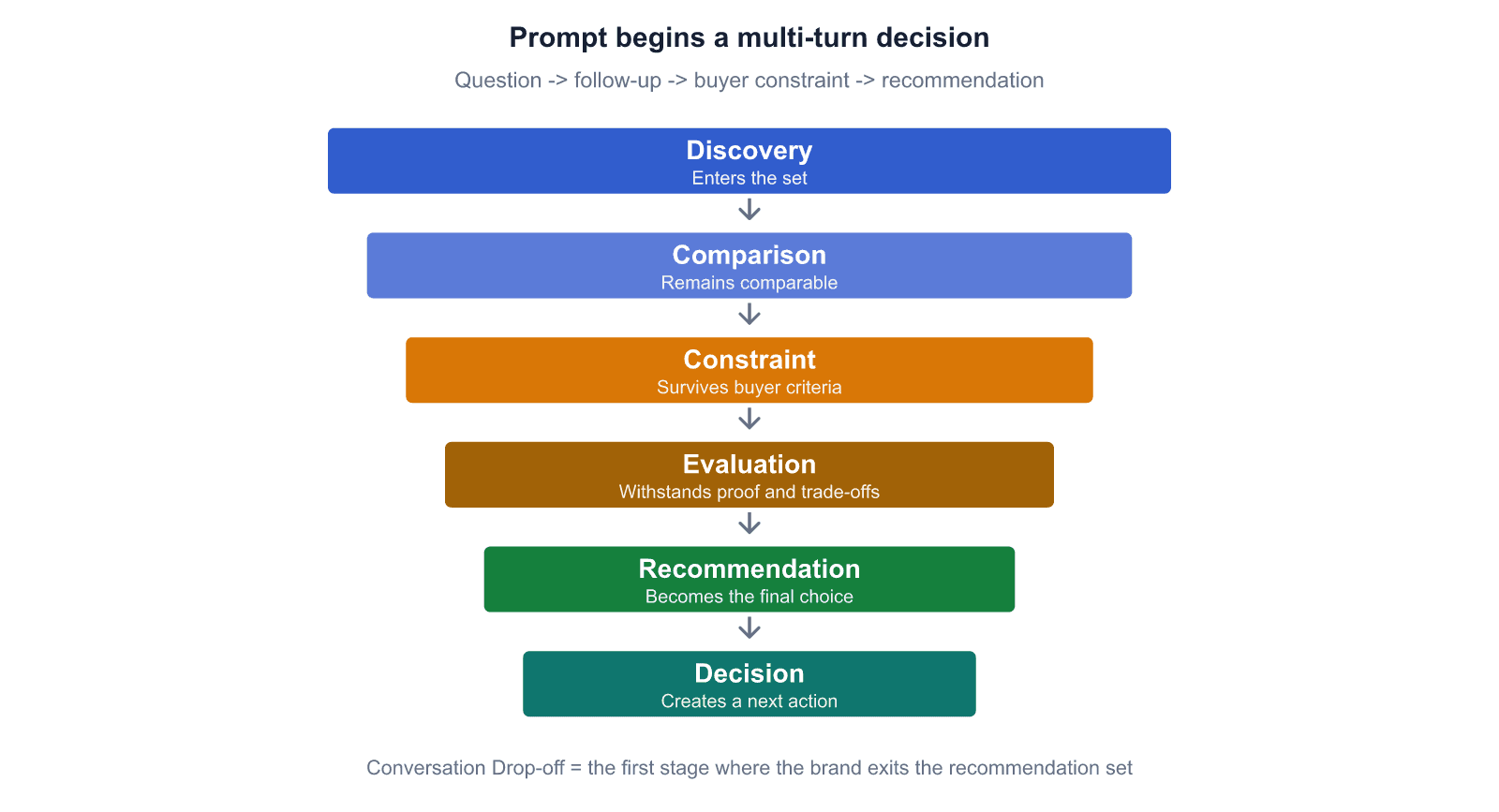
| Funnel stage | Buyer behavior | What the brand must prove |
|---|---|---|
| Discovery | The buyer asks a broad category question | The brand is relevant enough to enter the set |
| Comparison | The buyer asks how options differ | The position is specific and comparable |
| Constraint | The buyer adds price, speed, security, compliance, or fit requirements | The claim survives the condition that changes the decision |
| Evaluation | The buyer tests evidence and trade-offs | The brand has grounded proof, not only broad awareness |
| Recommendation | The system narrows to a final choice | The answer can justify fit for this buyer and constraint set |
| Decision | The buyer clicks, buys, saves, or asks a further question | The recommendation creates a useful next action |
Conversation drop-off is the stage at which a brand disappears from the recommendation set. It is the AI-search analogue of funnel abandonment. The useful question changes from "Was the brand mentioned?" to "Through which stage did the brand persist?"
That change matters for content. A company that enters discovery but drops at a price question does not need more generic awareness content. It needs clear, truthful price and value evidence. A company that loses at a security question needs machine-readable security material and documented boundaries. The diagnosis should follow the turn where the brand disappears.
What Does the Conversation Analytics Framework Measure?
The Conversation Analytics Framework, or CAF, organizes the measurement work into five sequential stages. Each stage has a distinct question, failure mode, and optimization lever.
| CAF stage | Decision question | Failure mode | Practical lever |
|---|---|---|---|
| Visibility | Does the brand enter at all? | Absent from non-branded intent | Corpus coverage and retrieval eligibility |
| Persistence | How long does it stay recommended? | Present at turn one, gone by turn three | Grounding depth across related topics |
| Evaluation | How does it fare under comparison and constraint? | Collapses under a price or compliance objection | Topic-complete content for the relevant condition |
| Preference | Does confidence rise or fall across turns? | Negative recommendation momentum | Consistency and corroboration |
| Recommendation | Is it the final answer? | An early mention that never converts | Decision-turn dominance |
CAF is a survival chain. A brand cannot win recommendation without surviving evaluation. It cannot survive evaluation without persistence. It cannot persist without visibility.
The five stages also help connect conversation measurement to the rest of an AI-search program. AI Search's Matchmaker Problem explains why recommendations depend on audience, workflow, stack, budget, and exclusions instead of one generic "best" claim. CAF supplies the measurement layer: it shows whether those fit signals hold when the buyer actually introduces a constraint.
Which Metrics Make Conversation Analytics Operational?
The framework needs a metric vocabulary, not a vague instruction to "track conversations." These primitives turn a multi-turn exchange into inspectable evidence.
| Metric | Definition | Decision it supports |
|---|---|---|
| Mention Persistence | Mean number of turns a brand stays recommended after first appearing | Is the brand only a discovery mention? |
| Brand Survival Rate | Probability that a brand is still recommended at turn n | Which brand survives to the decision turn? |
| Conversation Drop-off | Survival measured by funnel stage | Where does the brand disappear? |
| Competitive Entry Rate | Distribution of the turn at which the first competitor enters | When does the comparison set become contested? |
| Recommendation Momentum | Slope of recommendation confidence across turns | Is the model becoming more or less confident in the brand? |
| Recommendation Stability | Consistency of the final recommendation across identical replays | Is the apparent win repeatable or noisy? |
| Conversation Coverage | Fraction of decision topics where the brand survives | Which buyer topics are materially covered? |
| Conversation Share | Turn-weighted share of recommendations | How much recommendation presence does the brand hold near the decision? |
| Conversation Paths | Distinct journeys through the funnel | What recurring routes lead to or away from the brand? |
| Conversation Replay | Turn-by-turn trace of the recommendation set | What specifically changed in a comparable conversation? |
| Prompt Cohorts | Conversations grouped by intent, such as buying, research, or comparison | Are unlike queries being mixed into one score? |
Two of these metrics are particularly important. Brand Survival Rate treats recommendation as a survival process: S(n) is the probability that a brand remains recommended at turn n. Two brands can have identical first-response visibility and sharply different survival curves.
Recommendation Stability treats repeated final recommendations as a distribution. A brand that wins once but changes frequently across identical replays has not established a durable preference. As AI Search Is a Weather System explains, a single screenshot is an observation. Conversation Analytics applies the same discipline to the final recommendation rather than stopping at turn one.
A worked diagnosis
Consider a project-management SaaS called Acme. A prompt monitor finds Acme in the first response to "best project management tools" 90% of the time. That looks like a win until the conversation is replayed across relevant constraints.
| Measurement | Acme result | What it means |
|---|---|---|
| First-response visibility | 90% | Strong discovery entry |
| Mention Persistence | 1.3 turns | Acme disappears soon after discovery |
| Rival persistence | 4.6 turns | A competitor survives further into evaluation |
| Brand Survival Rate | S(1) = 1.0, S(4) = 0.2 | Four in five conversations no longer recommend Acme by turn four |
| Recommendation Stability | Low across 40 replays | The occasional final win is not a reliable preference |
If Acme drops when the buyer asks about agile sprints and SSO, the diagnosis is loss at the evaluation turn on those constraints, not "get more first mentions." The next action is topic-complete content and proof for those objections, with a scope that the product can support.
What Did the Constraint Experiment Show?
The central AEOsim experiment tested whether discovery visibility determines the final recommendation. It used a fixed five-turn ladder over a five-pharmacy brand universe, 12 buying seeds, and one OpenAI engine.
The neutral and constraint arms began with an identical discovery turn, where the same brand was listed first in 100% of conversations. The only difference came in follow-up turns:
- The constraint arm introduced ordinary purchase criteria such as reliability, delivery, price, and authenticity.
- The neutral control used content-free follow-ups such as "tell me more" and "anything else?"
- A constraint-inversion control emphasized different axes to test whether the model was simply returning to a fixed favorite.
| Metric | Neutral control | Constraint arm |
|---|---|---|
| First-listed brand becomes final recommendation | 100% (72/72) | 9% (6/65), 95% CI 3-17% |
| Recommendation churn | 7% | 90% |
| Discovery leader wins | 72/72 | 6/65 |
| Turn the eventual winner takes the lead | T1 | T2 (59/59) |
AEOsim measurement. Both arms shared the same discovery turn.
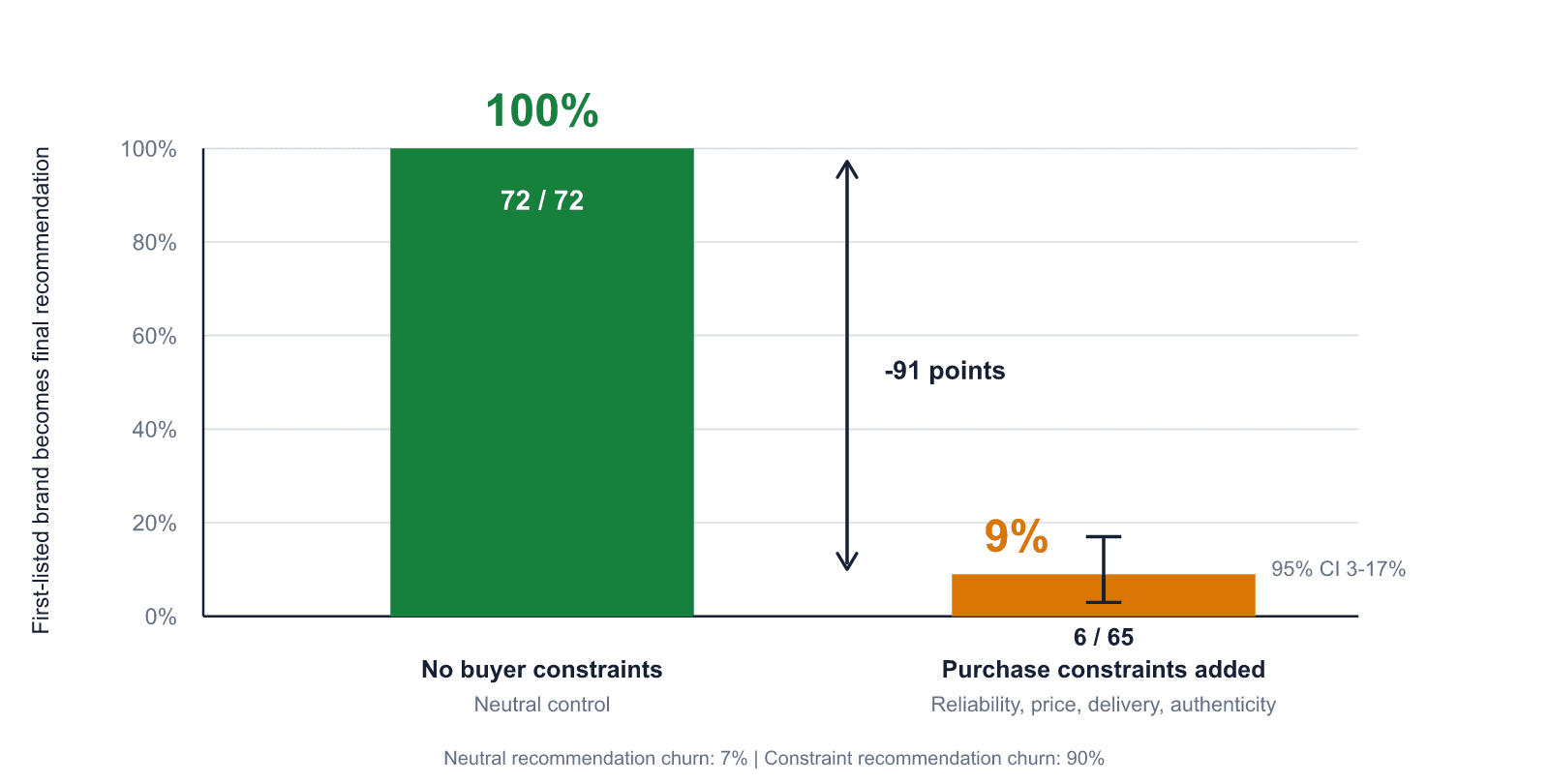
Without buyer constraints, the discovery leader remained the final recommendation in all 72 neutral conversations. When ordinary purchase conditions were introduced, that relationship fell by 91 percentage points. The eventual winner took the lead at the comparison turn, then the final turn largely ratified that new position.
The result did not appear to be simple conversational pressure. Neutral control churn was only 7%, and a direct "are you sure?" probe flipped the recommendation in 0 of 12 conversations. The working interpretation is that the system re-ranked options on the buyer's criteria.
The winner followed the constraint
The second control held discovery fixed and changed the buyer's stated priority. A different brand won on each relevant axis.
| Constraint emphasized | Final recommendation pattern | What it rules out |
|---|---|---|
| Lowest price | Brand B won 31% of final recommendations; the remaining 69% were Brand D or no tracked brand | The discovery leader did not keep winning by default |
| Widest catalogue | Brand A, the discovery-turn leader, won 36/36 | The original leader could still win when the constraint fit it |
| Fastest delivery | Brand C won 32/36, or 89% | A different criterion selected a different brand |
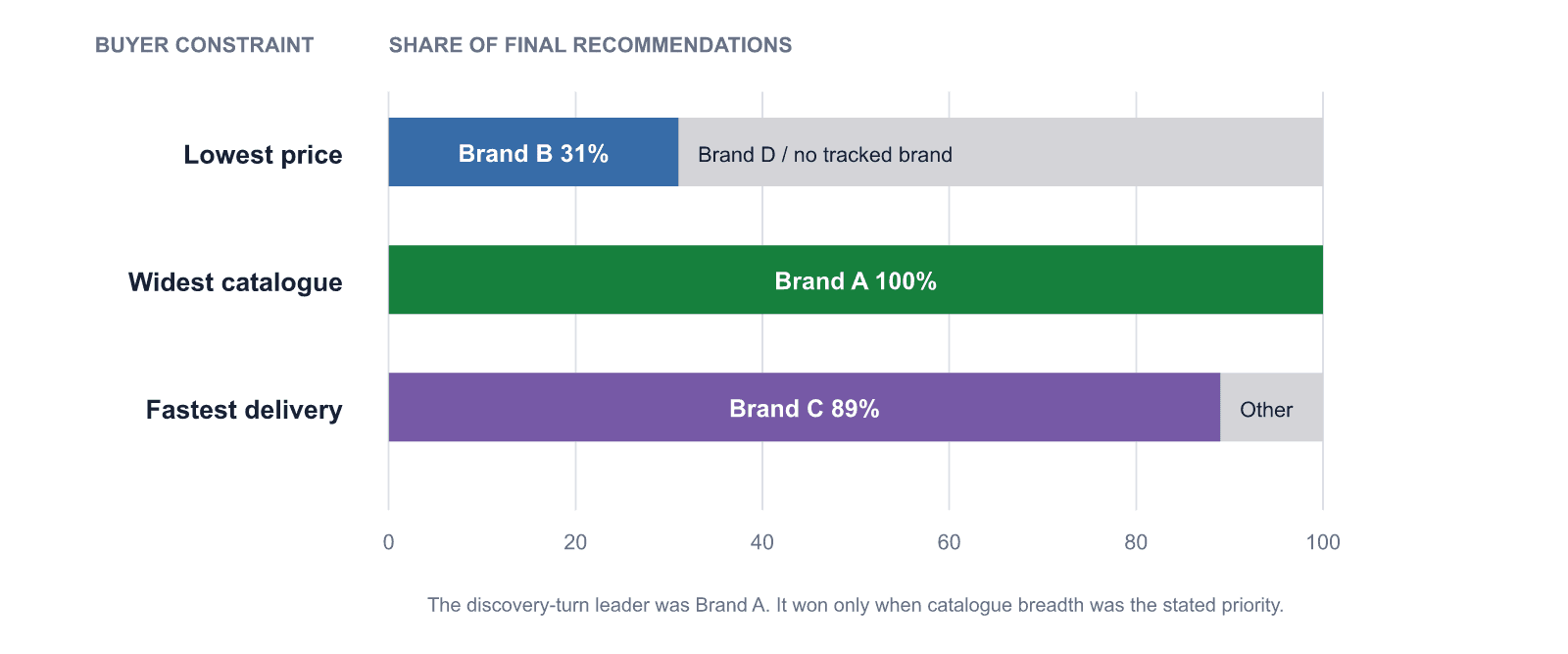
If the model were merely returning to a fixed favorite, one brand would have won under every axis. Instead, the winner changed with the stated criterion. The transferable result is not the identity of any brand in one pharmacy setup. It is the mechanism: discovery visibility does not determine recommendation once a buyer applies decision-relevant constraints.
How Should Teams Use Conversation Analytics?
Start with a small set of buying conversations rather than a huge prompt list. Each conversation should represent a decision path with a broad discovery turn, a comparison turn, a constraint, an evaluation request, and a recommendation request.
| Step | What to record | What the record tells you |
|---|---|---|
| Define prompt cohorts | Buying, research, comparison, and category-specific routes | Whether like-for-like conversations are being compared |
| Create a fixed turn ladder | Discovery, comparison, constraint, evaluation, recommendation | Where a brand enters, persists, or drops out |
| Run repeated replays | Same conversation across a controlled sample | Whether the final recommendation is stable |
| Test real constraints | Price, security, delivery, compliance, integrations, or use-case fit | Which objections change the winner |
| Diagnose the drop-off | The first stage where the brand exits the set | Whether the next fix is retrieval, positioning, evidence, or fit content |
| Compare on-site outcomes separately | AI referral sessions, engagement, conversion, and landing-page fit | Whether observed visits create business value after the chat |
The final step should remain separate from the conversation score. How to Measure GEO Success in GA4 shows how to inspect engagement and conversion quality once AI-referred visitors arrive. Conversation Analytics measures the answer-side decision path; GA4 measures the observable on-site behavior. Neither metric can replace the other.
For practitioners, the priority order changes:
- Stop treating the first mention as the destination. It is an entry signal.
- Diagnose the exact drop-off stage before producing more content.
- Make each important buyer constraint answerable with specific evidence and boundaries.
- Run the same conversation across repeated samples and relevant engines before calling a recommendation a win.
- Preserve the distinction between an AI answer's influence and a click or conversion that analytics can observe.
The remaining research agenda is practical: conversation-length distributions, survival curves at turns 2, 4, 6, and 8, competitor entry percentiles, objection survival by constraint, recommendation entropy across 25 to 100 replays, cross-engine divergence, and category-specific coverage. These questions turn a broad claim about AI visibility into a researchable operating system.
To run this kind of measurement on your own category prompts, see Analytika.
FAQ
Is Conversation Analytics the same as prompt monitoring?
No. Prompt monitoring measures a brand's visibility in a response, often the first response. Conversation Analytics measures the brand's path through multiple turns: visibility, persistence, evaluation under constraints, preference, and final recommendation. Prompt monitoring can be a useful input to Conversation Analytics, but it does not describe the whole conversation.
What is Conversation Drop-off in AI search?
Conversation Drop-off is the stage at which a brand disappears from the recommendation set. A brand might enter at discovery, survive comparison, and disappear when the buyer introduces a security, price, delivery, or compliance constraint. The drop-off stage tells a team what decision-critical content or proof is missing.
Does a high first-response mention rate mean a brand will be recommended?
Not necessarily. In AEOsim's controlled experiment, the first-listed brand became the final recommendation in every neutral conversation, but only 9% of constraint conversations. The experiment was limited to one engine and one category, so it should not be generalized as a universal rate. It does show why first-response visibility and final recommendation must be measured separately.
How many replays should a Conversation Analytics study use?
There is no universal threshold. The research agenda proposes measuring recommendation stability over 25 to 100 identical replays, because AI answers can regenerate and differ by engine or mode. The right number depends on the category, decision risk, and how much variance the first samples reveal.
What content should a brand create after finding a constraint-related drop-off?
Create evidence-rich material for the exact buyer condition that caused the drop-off. That may be pricing and value documentation, security and compliance evidence, delivery or implementation detail, integration coverage, product limits, or a clear "best for" and "avoid if" statement. Do not answer a constraint failure with broader generic awareness content.
Arnav Narang is an IIT Delhi engineer and researcher with deep expertise in data science, LLM visibility, and simulation methods, and the founder of AEOsim. This piece was originally published on The GEO Community. Measure multi-turn AI visibility with Analytika. Related measurement: Clarification as a Branch Point.