AEOsim blog
Ground prompts in business data, not GSC keywords
Table of contents
Real keywords, invented questions
The most common way to build an AI visibility prompt set is to export a brand's top Google Search Console keywords and turn each one into a question. "Cabin luggage 7kg" becomes "What is the best cabin luggage under 7kg?" It feels grounded, because the keywords came from real searches.
It is not. The keywords are real; the questions are a guess. Search queries are short, because typing into a search box is expensive. Chat prompts are long, conversational, and loaded with context: who the buyer is, what they already own, what went wrong last time. The mapping from one to the other is an assumption nobody measured.
Keyword templating has three further problems:
- It only sees demand you already capture. GSC shows queries where your site appeared. The questions where competitors own the conversation never show up.
- It is flat. Every keyword becomes one prompt of equal weight, regardless of how close it is to a purchase.
- It stops at turn one. Keywords describe how buyers open. They say nothing about the constraint or objection that decides the pick later in the chat.
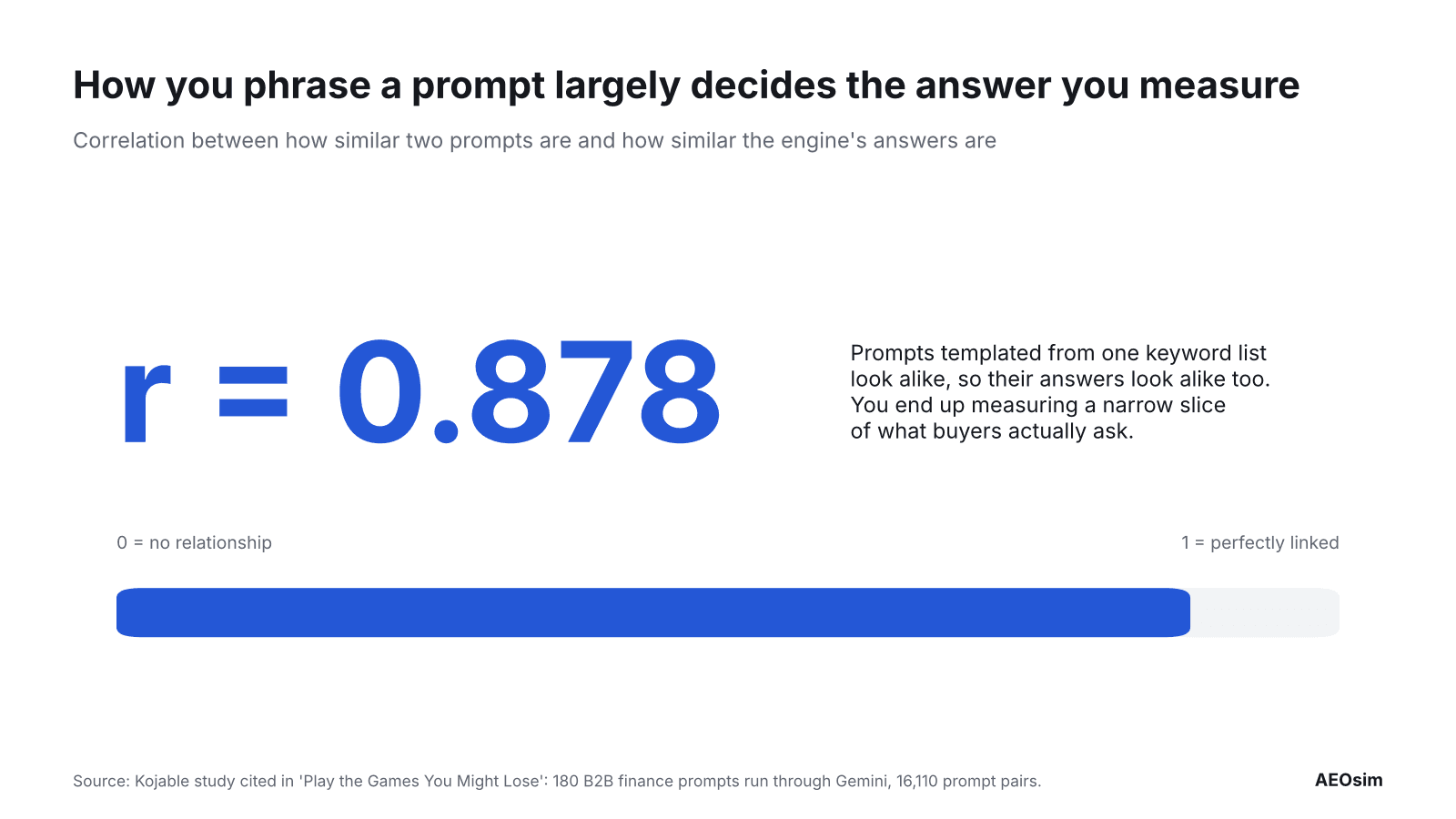
Better grounding usually sits inside the business, not in a keyword tool (Synthetic Data, Part 1).
Four levers for better-grounded prompts
1. Richer data sources
Use the records that describe the decision a buyer is making, not just the words they once typed. Support tickets, return reasons, pre-sales chat logs, product review text, and the questions your sales or customer team answers every day all carry the constraints and objections that decide a pick. They are harder to collect than a keyword export, and worth it.
2. A prompt-intelligence framework
Turn that raw data into structured prompts with a repeatable pipeline: extract the buyer's role, intent, constraints and objections; group them into buying journeys; then write each journey as a multi-turn script. Research on intent- and persona-based prompt generation, such as the Role-Augmented Intent-Driven G-SEO paper (arXiv:2508.11158), shows modelling intent and persona changes measured visibility. Avoid the closed loop where one model invents prompts for the same class of model to answer.
3. ROI-weighted prompts
Not every prompt is worth the same. Weight each one by how close it sits to a purchase and by the order value at stake, not just by guessed frequency. A question asked about a ₹12,000 suitcase right before checkout deserves more weight than a general "what is a hard-shell bag?" question. Record the weights in the manifest so a moving score can be traced to the brand or to the weighting.
4. Clean splits
Keep prompt classes separate and score them separately:
- Branded vs unbranded. A branded failure (reputation, eligibility) and an unbranded failure (competitive visibility) have opposite causes. Blending them hides both.
- Persona. The same intent asked as a first-time buyer and a repeat buyer can produce different picks.
- Funnel stage. Discovery, comparison and decision prompts answer different questions.
- Held-out families. Keep some prompts out of reporting, so gains are not just gains against the instrument.
Where the data lives in an Indian ecommerce business
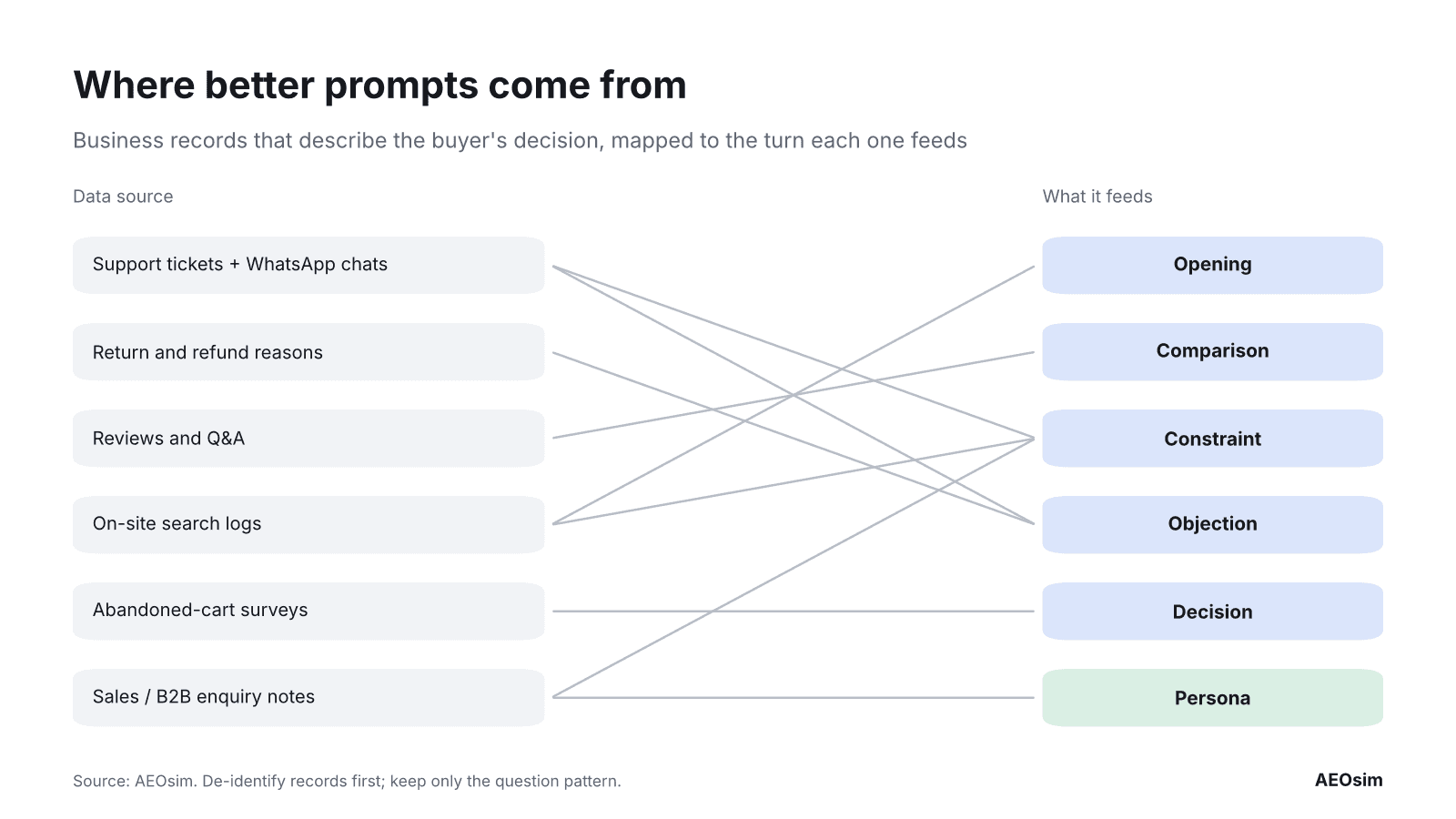
| Source | What it gives you | Turn it feeds |
|---|---|---|
| Customer support tickets and WhatsApp chats | Pre-purchase doubts in the buyer's own words, often in Hinglish | Constraint, objection |
| Return and refund reasons | The fit, size or quality issues buyers worry about | Objection |
| Product reviews and Q&A (yours and marketplaces) | Attributes buyers compare on, and comparisons they make | Comparison |
| On-site search logs | What buyers look for once they arrive, including failed searches | Opening, constraint |
| Abandoned-cart surveys | What stopped the purchase at the last step | Decision |
| Sales or B2B enquiry notes | Bulk, gifting and corporate buyer needs | Persona, constraint |
Start with two of these, not all six. Pull a few hundred records, tag each by intent and constraint, and write ten buying journeys from the patterns. That set will tell you more than a thousand keyword-templated prompts.
Two things to keep in mind:
- De-identify before use. Strip names, phone numbers and order IDs. Only the question pattern matters.
- Keyword data still has a job. GSC is useful for checking coverage and for the opening turn. It just should not be the whole prompt set.
Related reading: Chat Is the New Funnel · Building a prompt set that represents real buyers · Syntheticity is a spectrum, not a flaw
Want prompts built from your own business data? Book an Analytika demo.
Sources
- Synthetic Data in LLM Visibility Tools, Part 1, AEOsim and Kojable
- Top 7 AI Visibility and AEO/GEO Monitoring Tools in 2026, AEOsim
- Role-Augmented Intent-Driven G-SEO, arXiv:2508.11158